
Email:dennis@sun-cart.com Whatsapp:+86 13696971344
Electric Golf Carts for Farm
Electric Golf Carts for Farm
Efficient, Versatile, and Sustainable Utility Vehicles
Farms, ranches, orchards, vineyards, and agricultural operations of all sizes require efficient, low-cost transportation for daily tasks. From moving tools and feed between barns to checking irrigation systems, transporting harvest crews, and patrolling fence lines, electric golf carts have become indispensable utility vehicles for modern agricultural operations.
Unlike traditional utility vehicles (UTVs) that run on gas or require significant maintenance, electric golf carts offer zero emissions, near-silent operation, and dramatically lower operating costs. According to industry data, the global market for low-speed electric vehicles (LSVs) in agricultural and commercial applications is projected to grow significantly through 2030, driven by demand for sustainable, cost-effective farm mobility solutions .
Sun-Cart delivers purpose-built electric golf carts for farms and agricultural operations, helping you achieve more efficient daily workflows, lower total cost of ownership, and support your land management goals — all while reducing your carbon footprint.
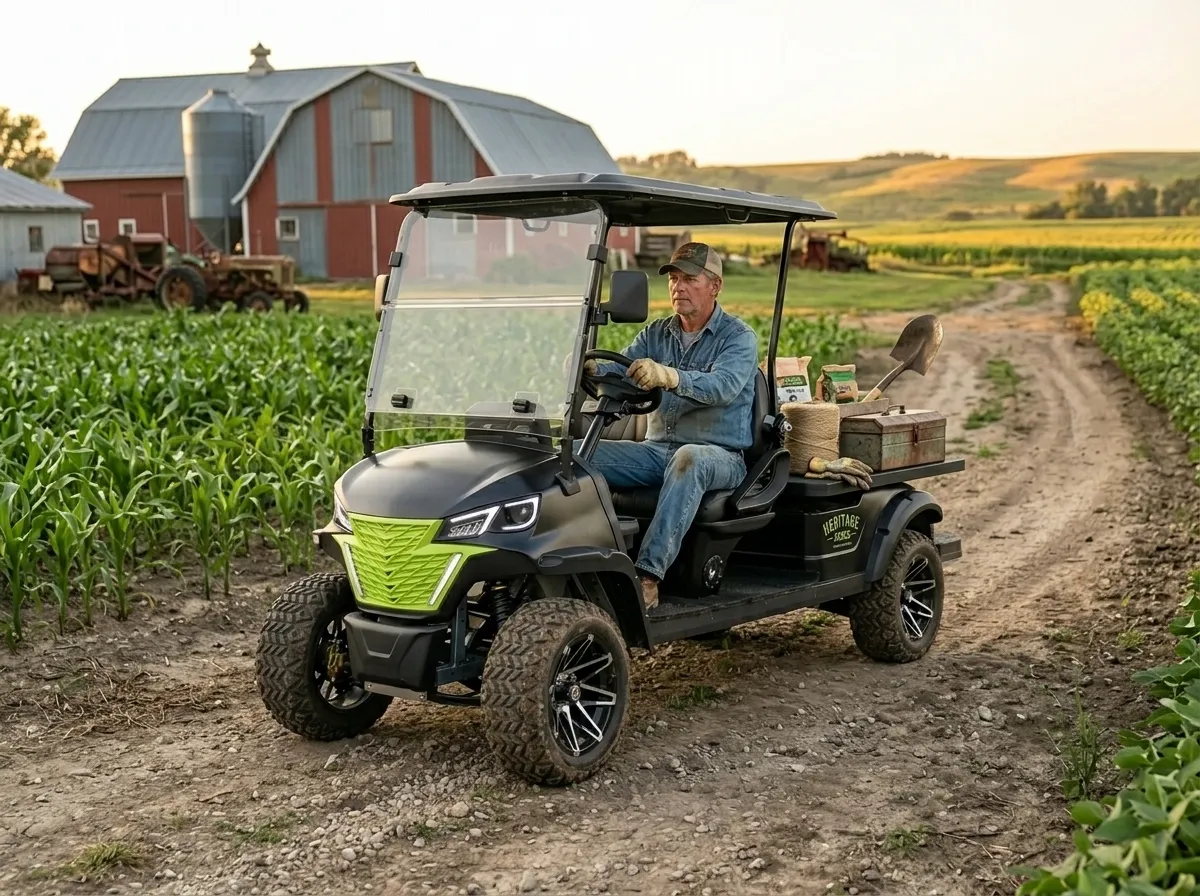
Electric Golf Carts for Farms – The Smart Alternative to Gas UTVs
Modern farming is all about efficiency, cost control, and sustainability. Yet many farms still rely on gas‑guzzling pickups or oversized UTVs for daily short‑haul tasks – moving feed, checking fence lines, transporting tools across fields, and shuttling workers between greenhouses and barns.
Today, a growing number of small and mid‑sized farms are switching to purpose‑built electric utility golf carts. With a 72V lithium system and all‑terrain tires, today’s farm‑grade electric carts offer genuine off‑road capability, 50–65 miles of range per charge, and zero exhaust emissions — all at a fraction of the purchase and operating cost of a traditional UTV.
The numbers speak for themselves. The global agricultural electric vehicles market is expanding rapidly, driven by the need for low‑cost, low‑emission mobility on working farms [4†L22-L25]. North America already accounts for nearly 45% of the electric utility vehicle market, and agriculture is one of the fastest‑growing segments [10†L15-L16]. For farm managers who want to move people and light cargo efficiently without compacting soil or burning expensive fuel, electric golf carts are emerging as a vital daily workhorse [11†L5-L8].
Four Core Pain Points for Hotels & Resorts
Farm-Wide Mobility & Daily Task Efficiency
The Problem: Farms and agricultural operations are sprawling. Workers need to move between fields, barns, equipment sheds, and livestock areas throughout the day. Using full-sized trucks or tractors for these short trips is inefficient, expensive, and causes unnecessary soil compaction and fuel consumption.
The Sun-Cart Solution: Deploy a fleet of electric golf carts designed for the unique demands of agricultural environments:
| Application | Benefit |
|---|---|
| Crew transport to fields | Move harvest crews efficiently across large properties |
| Livestock area checks | Quiet operation — no engine noise to disturb animals |
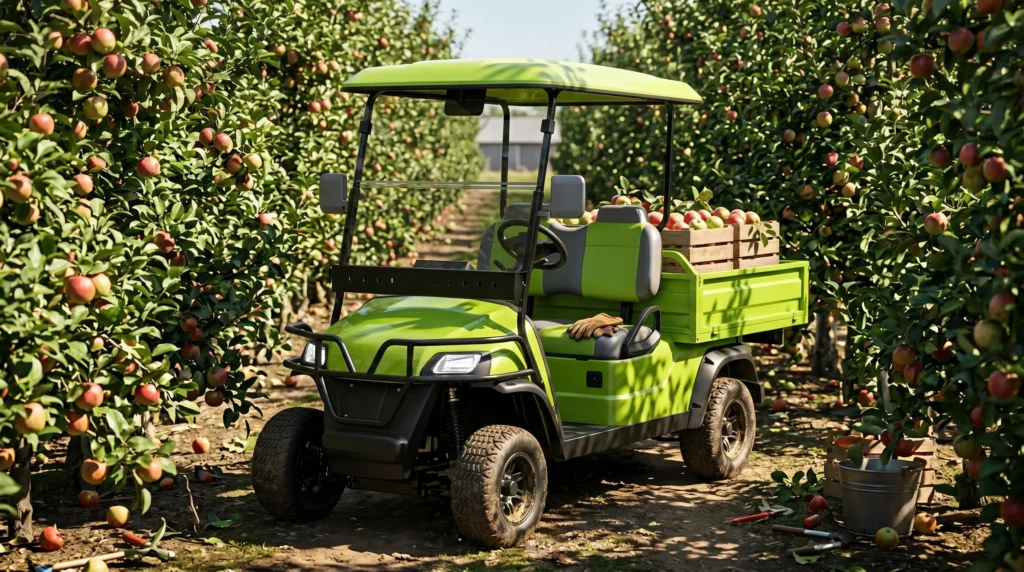
| Orchard/vineyard navigation | Compact size fits between rows |
| Equipment shed to field runs | Quick transport of tools and small parts |
Real-world example: Warren Wilson College’s Center for Working Lands uses electric golf carts for daily land management operations across 900 acres of forestry and agricultural land. The carts transport students, staff, and faculty while also serving as mobile microgrids for charging tools and equipment .
Tool, Feed & Harvest Transport
The Problem: Farms require constant movement of tools, feed, supplies, and harvested products. Gas-powered UTVs are expensive to purchase and maintain. Manual transport is labor-intensive and inefficient.
The Sun-Cart Solution: Our utility-focused electric golf carts with cargo configurations are purpose-built for farm transport needs:
Cargo bed capacity: Haul tools, feed bags, and supplies across the property
Tow-capable models: 2-inch ball hitches for towing small trailers, spreaders, or sprayers
Enclosed cargo options: Weather-resistant boxes for seed, supplies, or harvested produce
Fold-down rear seats: Convert from passenger to cargo mode as needed
Sustainable Land Management & Energy Independence
The Problem: Farmers and land managers are increasingly seeking ways to reduce operating costs and carbon footprints. Fuel costs fluctuate, and traditional gas-powered vehicles contribute to emissions. Many agricultural operations are exploring renewable energy integration but need practical, cost-effective entry points.
The Sun-Cart Solution: Our electric golf carts can integrate with farm energy systems:
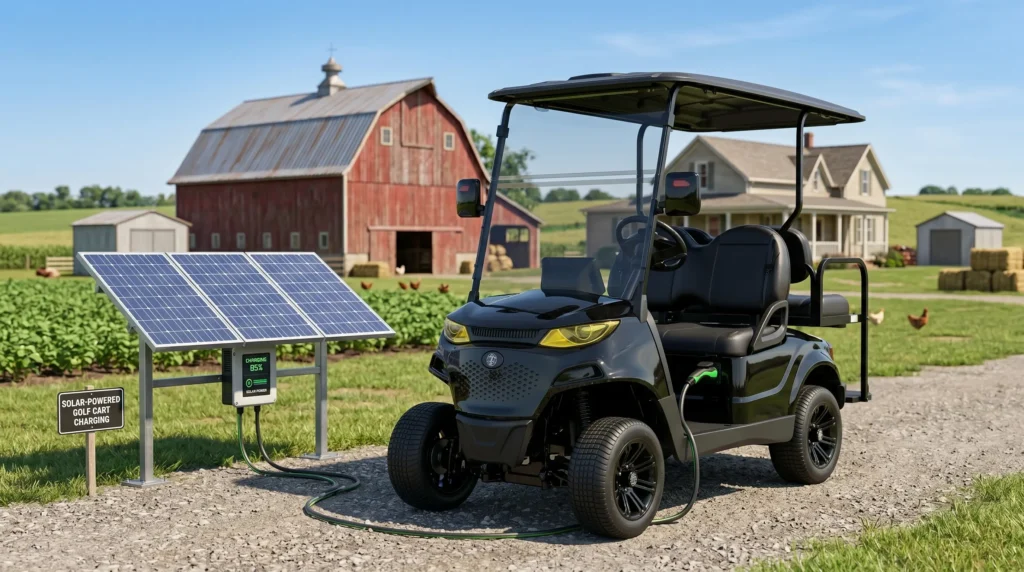
Solar charging ready: Compatible with solar charging setups — park in the sun to charge
Mobile microgrid capability: Can serve as portable power sources for tools, lighting, and equipment
Zero emissions: No exhaust fumes near greenhouses, livestock, or crops
Low operating cost: Pennies per mile vs. gas alternatives
Real-world example: Warren Wilson College converted their fleet of 12 golf carts from lead-acid to LiFePO₄ batteries with solar charging capability. Each cart integrates 5 kWh batteries with 340-watt solar panels, allowing them to self-charge while parked or driving in the sun. These carts can also serve as mobile microgrids to charge power tools, outdoor lighting, and sound systems .
Low Maintenance & Reliability
The Problem: Farm equipment already demands significant maintenance time and expense. Adding gas-powered UTVs to the fleet means oil changes, spark plugs, fuel filters, and engine repairs. Lead-acid batteries require weekly watering, terminal cleaning, and replacement every 2-3 years.
The Sun-Cart Solution: Our electric golf carts dramatically reduce maintenance burdens:
No oil changes – Electric motors have no engine oil
No spark plugs or fuel filters – Nothing to replace
No radiator or coolant – No overheating concerns
Zero battery maintenance – Sealed LiFePO₄ batteries require no watering or terminal cleaning
Regenerative braking – Extends brake life
5-year battery warranty – Long-term reliability
Why Choose Electric Carts for Your Hotels Resorts?
Ultra-Quiet Operation – Livestock-Friendly
Electric golf carts operate at approximately 55 decibels — far quieter than gas UTVs. No engine noise means:
Less stress on livestock – Animals aren‘t startled by loud vehicles
Early morning operations – Work without disturbing neighbors or family
Wildlife preservation – Minimal disturbance to natural habitats
Lithium Technology – Lower Total Cost of Ownership
| Comparison | Lead-Acid Battery | Sun-Cart Lithium Battery (LiFePO₄) |
|---|---|---|
| Charge Time | 8-10 hours | 2-3 hours (to 80%) |
| Lifespan | 2-3 years | 8-10 years |
| Cycle Life | 500-800 cycles | 2,000-5,000 cycles |
| Maintenance | Monthly watering, terminal cleaning | Zero maintenance |
| Weight (48V) | ~280 lbs (127 kg) | ~90 lbs (41 kg) – 40-60% lighter |
| Energy Efficiency | ~75% | ~95% |
| Consistent Power | Slows down as battery drains | Full speed until empty |
| Cold Weather Performance | Poor | Heated/insulated options available |
| Warranty | 1-2 years | 5 years |
🔋 Key Insight: Sun-Cart lithium batteries pay for themselves within 18-24 months for daily-use farm fleets. With 8-10 years of service life — 4x longer than lead-acid — farmers may never need to replace batteries during the vehicle's lifetime. Compatible with solar charging systems for energy-independent farm operations.
Zero Emissions – Support Sustainable Farming
Electric golf carts produce no tailpipe emissions. Benefits for agricultural operations:
No exhaust near greenhouses – Protect sensitive crops from fumes
Cleaner air for workers – No inhalation of exhaust during daily use
Align with conservation programs – Support NRCS and other sustainability initiatives
Carbon credit potential – Some programs offer incentives for fleet electrification
Solar Charging Ready – Energy Independence
Sun-Cart electric golf carts are compatible with solar charging systems, allowing you to:
Charge while parked in the sun – Reduce grid electricity costs
Integrate with farm solar arrays – Use existing renewable energy infrastructure
Serve as mobile power sources – Charge tools and equipment in the field
Real-world data: Warren Wilson College‘s solar-charged electric golf carts integrate 5 kWh LiFePO₄ batteries with 340-watt solar panels, demonstrating the feasibility of solar-powered farm mobility .
Compact & Maneuverable – Navigate Tight Spaces
Unlike full-sized trucks or tractors, electric golf carts can navigate:
Between orchard rows – Narrow pathways between trees and vines
Through barn doors – Standard doorways and confined animal areas
Along irrigation lines – Check and maintain systems without damaging equipment
Around greenhouses – Tight spaces between structures
Golf Bag Rack
Standard, holds 2 bags
Brand Paint
Course logo, custom colors
GPS Touchscreen
9-inch display with course map, yardage, green slope
Make It Yours – Full Customization
Cooler / Beverage Holder
Optional, enhances player experience
Sand/Seed Bottle
Standard, for divot repair
Electric Farm Utility Cart vs UTV: Which One Fits Your Operation?
Many farm managers face the same question: should you invest in a traditional gas‑powered UTV (Utility Task Vehicle) or switch to a modern electric golf cart configured for agricultural work? The answer depends on your daily tasks, terrain, and long‑term operating budget.
Below is a data‑driven comparison to help you decide.
Side‑by‑Side Comparison – Electric Golf Cart vs UTV
| Parameter | Electric Golf Cart (Farm‑Ready) | Traditional UTV (Gas / Diesel) |
|---|---|---|
| Upfront Cost | $6,000 – $15,000 | $12,000 – $25,000+ |
| Operating Cost per Mile | $0.03 – $0.05 (electricity) | $0.20 – $0.30+ (fuel) |
| Annual Maintenance Cost | $100 – $200 (no oil, no belts) | $500 – $1,200 (oil, filters, belts, spark plugs) |
| Lifespan (with proper care) | 10–15 years (lithium battery 8–10 years) | 10–15 years (but higher cumulative upkeep) |
| Noise Level | <65 dB – animal‑friendly | 70–85 dB – can stress livestock |
| Emissions | Zero tailpipe | CO₂, NOx, and particulate matter |
| Ground Pressure / Turf Damage | Very low (lightweight, <1,000 lbs) | High (1,500 – 2,500 lbs compacts soil) |
| Cargo Capacity | 400 – 1,000 lbs (with optional bed) | 1,000 – 2,000+ lbs |
| Towing Capacity | 1,000 – 2,000 lbs (with hitch) | 2,000 – 3,500+ lbs |
| Hill Climbing (Gradeability) | 25–30% (72V system) | 35–45% (but heavier) |
| Typical Applications | Crew shuttles, tool transport, light hauling, fence checking, livestock monitoring, greenhouse work | Heavy towing, extreme off‑road, large‑scale earthmoving, logging |
Source: Industry data & real‑world farm fleet reports
When to Choose a Farm Electric Golf Cart
✅ Your daily tasks involve short‑distance transport of workers, tools, feed, or harvested produce
✅ You operate on paved roads, gravel paths, orchards, vineyards, or well‑maintained pastures
✅ You want to minimize soil compaction and protect your land
✅ You need a quiet, low‑stress vehicle that won’t spook livestock
✅ You are looking for the lowest total cost of ownership over 5–10 years
✅ Your load weight rarely exceeds 1,000 lbs and towing needs are moderate
💡 For most small to mid‑sized farms, a purpose‑built 72V lithium electric golf cart with all‑terrain tires and a rear cargo box can replace a gas UTV for 80% of daily tasks – at half the purchase price and one‑fifth the operating cost.
When a UTV Is Still the Better Fit
✅ You regularly need to tow heavy equipment (e.g., round baler, water trailer, large spreader)
✅ Your terrain includes deep mud, steep rocky slopes, or unmaintained logging trails
✅ You consistently haul more than 1,500 lbs of material
✅ You are willing to pay higher fuel and maintenance bills for extreme off‑road capability
The Smart Upgrade Path for Farm Operations
If you already own a gas UTV but want to reduce daily operating costs, consider this hybrid approach:
Keep the UTV for heavy‑duty, low‑frequency jobs (once or twice a week)
Add one or two electric golf carts for high‑frequency, light‑duty daily tasks
Farmers who adopt this model typically see fuel savings of 60‑80% and maintenance cost reductions of 50‑70% within the first year.
Industry Data Backing the Shift
According to recent market analysis:
The global agricultural electric vehicles market is expanding at a CAGR of over 8%, driven by the need for low‑cost, low‑emission mobility on working farms.
North America accounts for nearly 45% of the electric utility vehicle market, and agriculture is one of the fastest‑growing segments.
Fuel and maintenance savings from switching light‑duty farm transport to electric can pay back the purchase price within 18–24 months.
Make Your Decision Based on Your Operation, Not the Label
You don’t necessarily need a “UTV” to get work done. For a majority of daily farm tasks – moving workers, checking fences, hauling feed, transporting tools – a well‑equipped electric golf cart is more cost‑effective, quieter, and gentler on your land.
When you do need raw pulling power, keep your gas UTV for those occasional heavy jobs. But for the work you do every day, go electric.
Ready to test a farm‑ready electric golf cart on your property?
Contact us for a demo or sample order.
📧 dennis@sun-cart.com
📞 WhatsApp: +86 19357388757
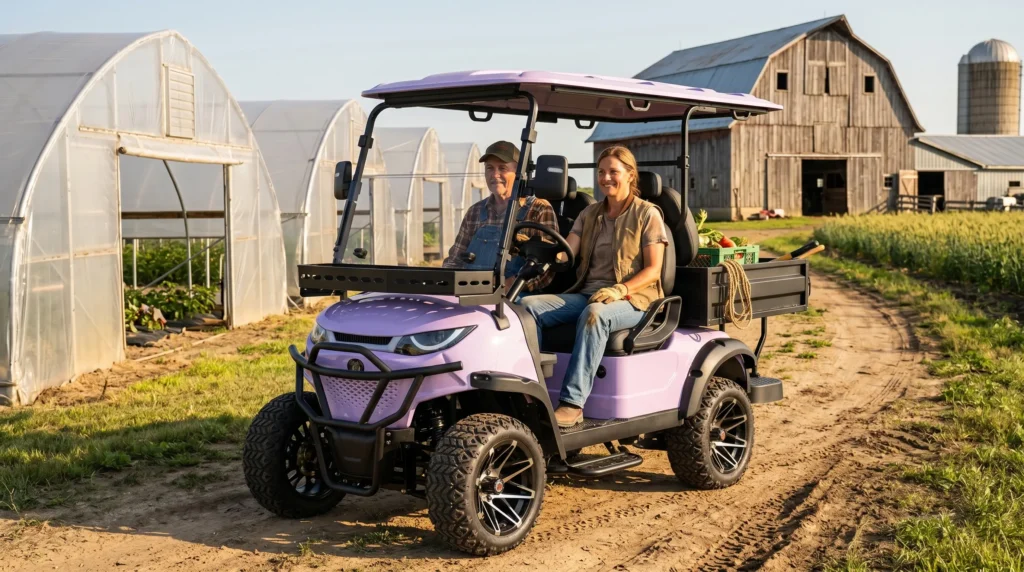
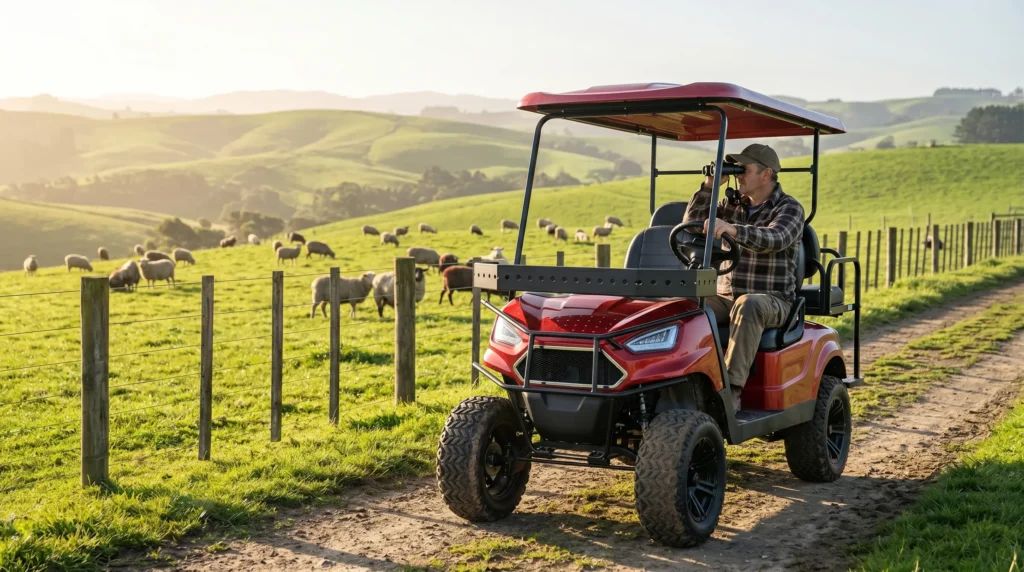
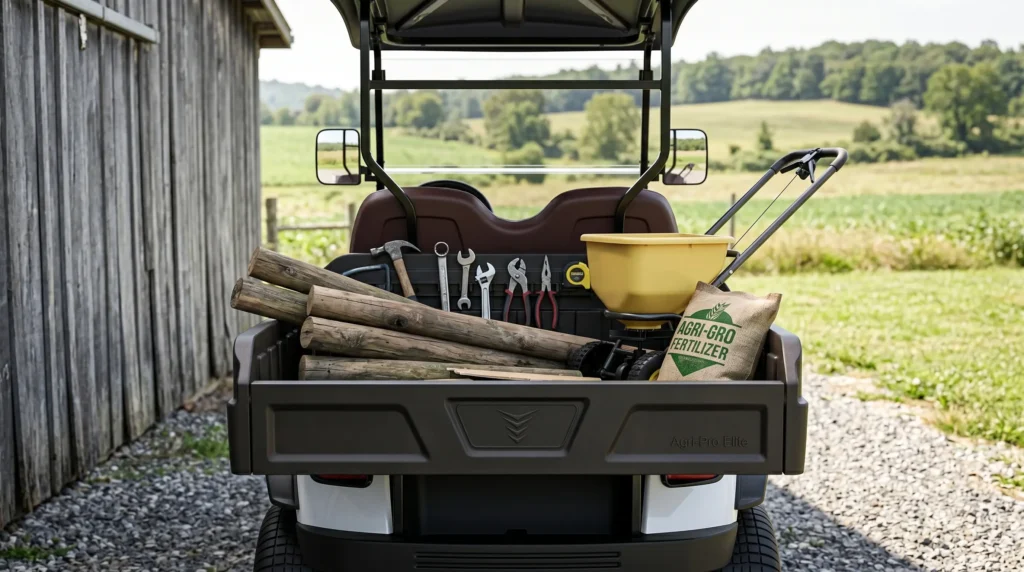
Electric Golf Cart Uses on the Farm – 5 Key Scenarios to Boost Efficiency
Ready to modernize your Farm fleet?
Ready to modernize your Farm fleet?
How do electric golf carts compare to gas UTVs for farm use?
Electric golf carts offer significantly lower operating costs (pennies per mile vs. dollars for gas), zero emissions, quiet operation (less stress on livestock), and minimal maintenance (no oil changes, spark plugs, or fuel filters).
Can these vehicles handle rough farm terrain?
Yes. Our all-terrain tire options and lifted suspension (12-inch ground clearance) provide capability for uneven ground, mud, and moderate slopes. For extremely rugged terrain, we recommend our 72V system with heavy-duty tires.
How long does a full charge last with farm use?
Under typical farm use (frequent stops, moderate speeds, mixed terrain), a full charge provides 6-8 hours of operation. Fast charging can restore 80% in 2-3 hours during lunch breaks.
Can electric golf carts be charged with solar power?
Yes. Our carts are compatible with solar charging systems. Warren Wilson College‘s demonstration project shows that carts with 340-watt solar panels can self-charge while parked or driving in the sun .
Can the carts serve as mobile power sources for tools and equipment?
Yes. With optional inverters, our carts can power electric tools, fence chargers, lights, and other equipment — serving as portable microgrids for remote farm tasks .
What is the warranty on the battery?
All Sun-Cart LiFePO₄ batteries come with a standard 5-year warranty — significantly longer than lead-acid alternatives.
Are these vehicles suitable for organic farm operations?
Yes. Zero emissions and quiet operation make electric golf carts ideal for certified organic operations that prioritize sustainable practices.
Can the vehicles be customized with farm branding?
Absolutely. We offer custom colors and logo placement to match your farm‘s brand.
Do you offer bulk discounts for farm fleets?
Yes. For orders of 6+ units, please contact us for volume pricing.
How do electric carts perform in winter conditions?
With proper battery management (keeping charged, storing above freezing when possible), LiFePO₄ batteries perform well in cold weather. Heated battery options are available for very cold climates.