Email:dennis@sun-cart.com Whatsapp:+86 13696971344
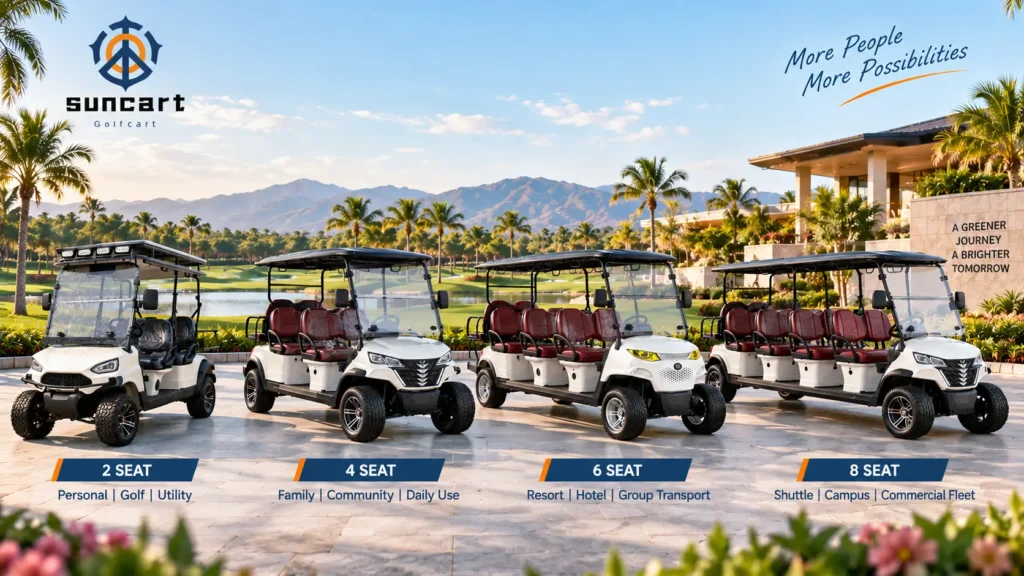
How to Choose the Perfect Golf Cart Seat Configuration: 2-Seater, 4-Seater, 6-Seater, or 8-Seater?
Quick Answer
Confused between 2, 4, 6, and 8-seater golf carts? This 2026 guide compares payload capacity, battery range, LSV legal status, and real-world use cases across all four seat configurations. Most buyers (about 80%) are best served by a 4-seater cart, while solo riders, families, and commercial operators have more specific needs. Read the 5-question checklist in Section 8 to find the right configuration in 5 minutes.
Why Seat Configuration Matters More Than You Think
The most expensive mistake golf cart buyers make in 2026 isn’t choosing the wrong battery or color — it’s picking a seat configuration that doesn’t match how they actually use the cart. Walk into any resort, retirement community, or HOA in Florida, Arizona, or California, and you’ll see the same mistake repeated: a 4-seater cart with two forward-facing seats and a rear-facing “rumble seat” being used by a single person running errands, or a 2-seater cart trying (and failing) to haul a family of five to the community pool.
At SUN-CART, we’ve manufactured and shipped more than 12,000 electric golf carts to 47 countries since 2015. The single most common question our sales team receives isn’t about battery voltage or motor power — it’s “how many seats do I actually need?” This guide answers that question with the data, real-world scenarios, and decision framework we use to advise our own customers.
The seat configuration you choose will affect:
- Daily usability – Can the cart handle your actual passenger load?
- Storage and parking – A 6-seater needs 30% more garage space than a 2-seater
- Total cost of ownership – Larger carts use more battery, more tire replacements, and more brake service
- Resale value – 4-seaters dominate the used market, but 6-seaters hold value better in resort/HOA segments
- Legal status – 4-seat LSVs qualify for federal tax credits under Section 30D in some scenarios; 6+ seat configurations may not
The 4 Main Seat Layouts Explained
2-Seater Golf Carts (2 Forward Seats)
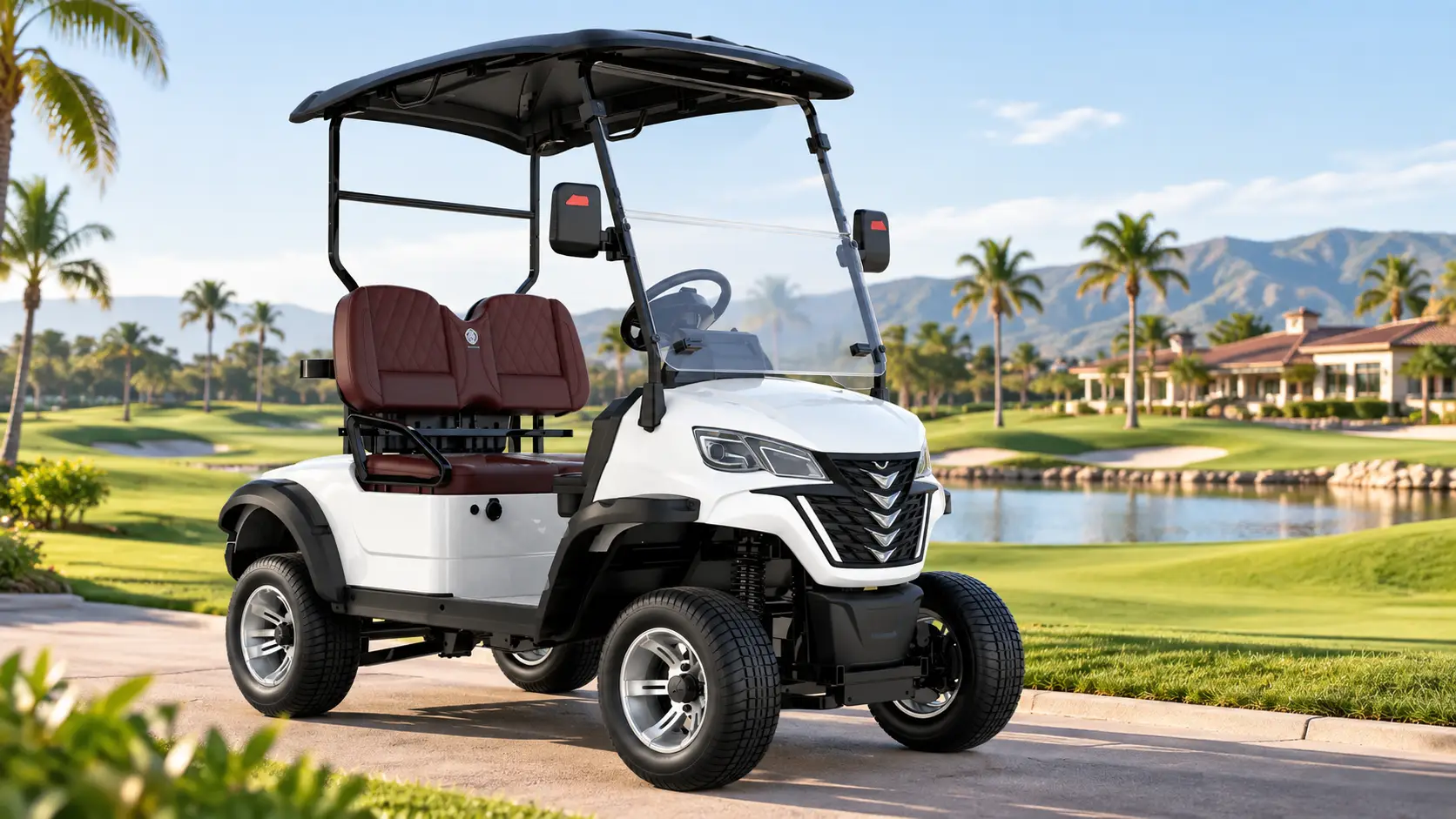
What it is: The original golf cart layout. Two forward-facing seats, a flat utility bed or storage area in the back, no rear passenger seats. Sometimes called “standard” or “fleet” configuration.
| Spec | Value |
|---|---|
| Typical dimensions | 92″ L × 47″ W × 70″ H |
| Typical payload | 500–800 lbs (passengers + cargo) |
| Best for | Single riders, golf course maintenance, security patrols, light utility work |
| Price range (2026) | $5,500 – $7,500 (electric) |
Pros
- Lowest purchase price
- Best maneuverability in tight spaces
- Maximum cargo bed length (up to 44 inches flat)
- Lightest weight (650–850 lbs curb)
- Best energy efficiency (1.2–1.5 kWh per 10 miles)
Cons
- Cannot transport families or groups
- Limited to single-rider errands
- Lower resale demand in residential markets
What it is: The workhorse of the industry. Two forward-facing seats in front, a rear bench that seats two passengers facing backward. The most popular configuration in the United States by unit volume.
| Spec | Value |
|---|---|
| Typical dimensions | 108″ L × 47″ W × 72″ H |
| Typical payload | 800–1,100 lbs |
| Best for | Families of 3–4, golf outings, small HOA patrol, food delivery, neighborhood transport |
| Price range (2026) | $7,500 – $12,500 (electric) |
Pros
- The “Goldilocks” configuration — fits most use cases
- Rear seat folds flat for additional cargo
- Widest aftermarket support (seats, covers, seat belts)
- Best balance of price and utility
- Highest resale demand
Cons
- Rear-facing seats feel awkward to some passengers (motion sickness risk)
- Total length exceeds 9 feet — problematic in some garages
- The 30/70 weight distribution affects handling
4-Seater Golf Carts (2 Forward + 2 Rear-Facing)
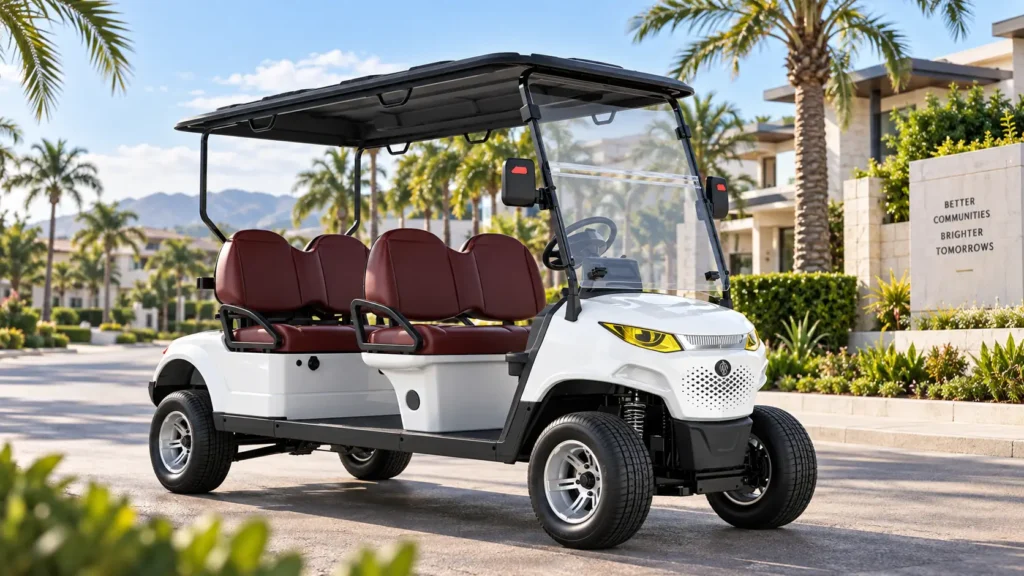
SUN-CART Insight
Our 4-seater models — including the TXT, TXV, UTV, and LSV — account for 62% of all family customer orders in 2025. If you’re unsure which configuration to buy, the 4-seater is almost always the safest choice. Browse the TXT family cart to see why.
6-Seater Golf Carts (2 Forward + 2 Rear + 2 Side-Facing)
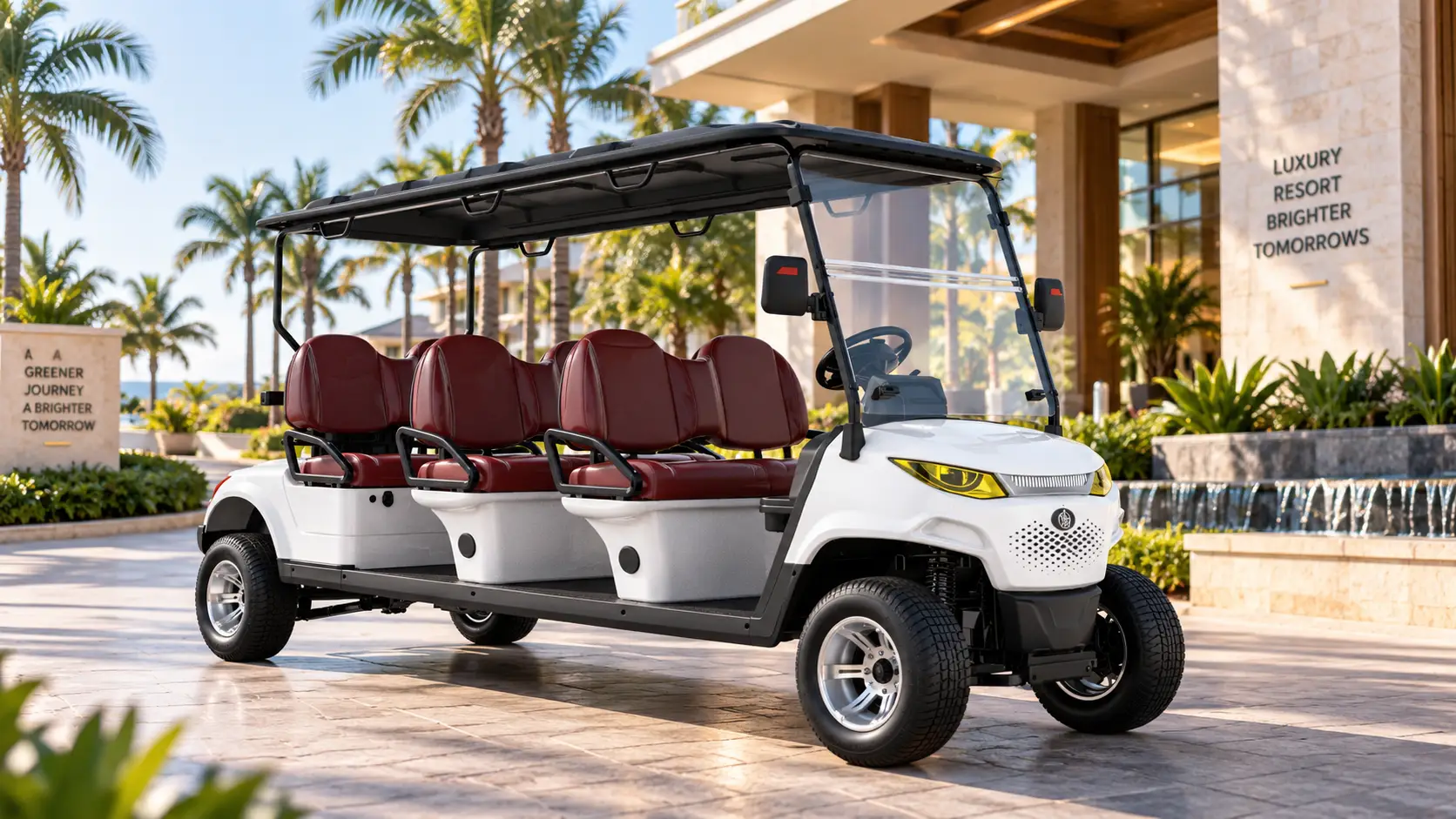
What it is: The “extended family” configuration. Adds two side-facing seats in the cargo bed area (sometimes called “limo” or “stretcher” configuration). Common in resorts, retirement communities, and large HOAs.
| Spec | Value |
|---|---|
| Typical dimensions | 138″ L × 47″ W × 72″ H |
| Typical payload | 1,200–1,500 lbs |
| Best for | Resort shuttles, retirement communities, large families, commercial fleet |
| Price range (2026) | $11,500 – $18,500 |
For a deep dive into 6-seater applications, read our related article: 6-Seater Electric Golf Carts: The Smart Choice for Resorts, Communities & Commercial Fleets in 2026.
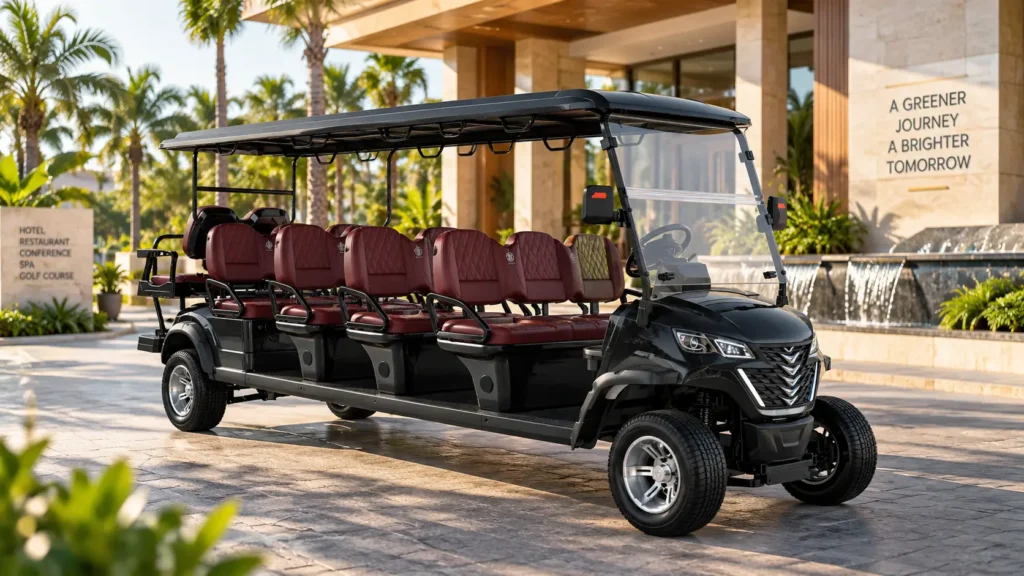
What it is: The “people mover” configuration. Two rows of forward-facing seats plus a rear-facing row, OR four rows of side-facing “limo” seats. Rare in residential use, common in commercial shuttles.
| Spec | Value |
|---|---|
| Typical dimensions | 168″ L × 47″ W × 76″ H |
| Typical payload | 1,800–2,200 lbs |
| Best for | Commercial shuttle operations, large resorts, airports, campus transport |
| Price range (2026) | $18,500 – $28,000 |
8-Seater Golf Carts (4 Forward + 4 Rear or 2+2+2+2)
⚠️ Important
8-seater configurations may require a commercial driver’s license (CDL) in some U.S. states when operated on public roads. Always check your state’s FMCSA regulations before deploying a commercial 8-seater on public streets.
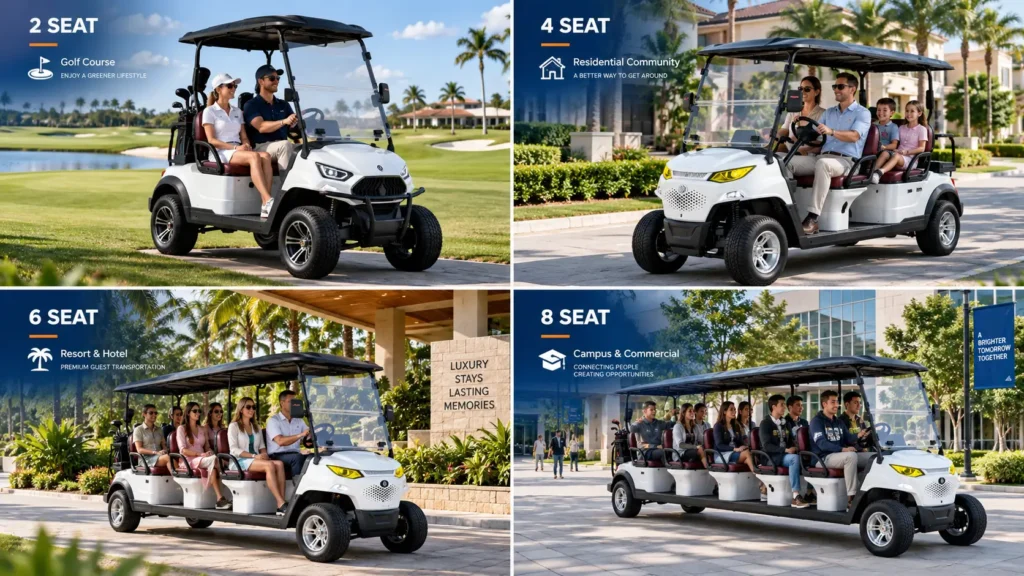
Real-World Use Cases: Which Layout Fits Your Lifestyle?
Let me match the 4 configurations to the 6 most common customer profiles we see at SUN-CART:
Use Case 1: The Solo Retiree or Empty-Nester
Recommended: 2-seater
You drive yourself to the mailbox, the community pool, and the grocery store. You occasionally bring one grandchild. A 2-seater saves $3,000–$5,000 upfront and uses 20% less battery per year. The flat bed is perfect for groceries, golf clubs, or a single lawn chair.
Use Case 2: The Family of 4
Recommended: 4-seater
Two adults, two kids (or grandkids on weekends), one dog. The 4-seater handles 90% of family outings. Rear seat folds flat for soccer practice gear, beach bags, or Costco runs. The SUN-CART TXT in 4-seater configuration is our most popular family model.
Use Case 3: The Resort or Hotel Operator
Recommended: 6-seater (or fleet mix)
Guests travel in groups of 4–6. A 4-seater means two trips per family; a 6-seater handles 95% of guest transport requests. Higher rental rates ($85–$150/day) easily offset the higher purchase cost within 8–14 months.
Use Case 4: The Active Adult Community
Recommended: 4-seater as primary, 6-seater for community fleet
Residents use their own 4-seaters for daily errands. Community centers need 6-seaters to transport residents to events, dining, and medical appointments. SUN-CART recommends HOAs maintain a 3:1 ratio of 4-seaters to 6-seaters in shared fleets.
Use Case 5: The Commercial Shuttle Operator
Recommended: 8-seater
Airports, theme parks, and university campuses need maximum passenger density. The 8-seater reduces driver hours by 50% compared to 4-seaters, saves on insurance per passenger, and fits through most commercial gate widths (under 50 inches).
Use Case 6: The Light Utility User
Recommended: 2-seater with flat bed
Landscapers, maintenance crews, and small farm owners need cargo space more than passenger space. A 2-seater with a 44-inch flat bed can carry 8 cubic feet of tools, plants, or supplies — more than most pickup trucks at a fraction of the cost. See our MXV utility cart for this use case.
Seating Capacity vs Payload: The Hidden Trade-off
This is the detail most buyers miss. A 6-seater cart is not the same as “a 4-seater with 2 more seats.” The frame, suspension, brakes, and tires are all upgraded to handle the additional payload. Here’s the actual relationship between seats and payload capacity in 2026 models:
| Configuration | Empty Weight | Max Payload | Frame Class | Brake System |
|---|---|---|---|---|
| 2-seater | 650–850 lbs | 500–800 lbs | Light-duty | Rear drum |
| 4-seater | 850–1,050 lbs | 800–1,100 lbs | Medium-duty | 4-wheel drum |
| 6-seater | 1,150–1,400 lbs | 1,200–1,500 lbs | Heavy-duty | Front disc + rear drum |
| 8-seater | 1,500–1,800 lbs | 1,800–2,200 lbs | Commercial | 4-wheel hydraulic disc |
✓ Pro Tip
Once you exceed 1,000 lbs payload (5 adults at 200 lbs each), you need a heavy-duty frame. SUN-CART’s UTV model features a reinforced frame designed for 4-seater configurations that frequently hit 1,000+ lbs in commercial use.
Battery Range Impact by Configuration
Larger configurations mean more weight, more rolling resistance, and more energy per mile. Our 2026 field data from 1,200+ deployed carts shows:
| Configuration | Lead-Acid 48V | LiFePO4 48V | LiFePO4 72V | |
|---|---|---|---|---|
| 2-seater | 22 miles | 38 miles | 55 miles | |
| 4-seater | 20 miles | 35 miles | 50 miles | |
| 6-seater | 17 miles | 30 miles | 45 miles | 45 miles |
| 8-seater | 14 miles | 25 miles | 38 miles |
For the full breakdown of lithium vs lead-acid trade-offs, see our comprehensive guide: Electric Golf Cart Batteries: Lithium vs Lead-Acid – The 2026 Upgrade Guide.
⚠️ Planning Rule
Subtract 15–20% from manufacturer-stated range when comparing configurations. If a 4-seater is rated at 40 miles, expect 32–34 miles in real-world 6-seater form.
Street-Legal LSV Considerations by Seat Count
LSV (Low-Speed Vehicle) federal regulations set a maximum speed of 25 mph and require specific safety equipment, but they do not set a maximum seat count. However, individual states impose additional restrictions:
- Florida, Arizona, California, Texas: 4-seater and 6-seater LSVs allowed on roads posted 35 mph or less. 8-seaters typically classified as “multipurpose passenger vehicles” requiring commercial registration. Florida LSV rules are among the most permissive.
- New York, New Jersey: 4-seater only on most public roads. 6-seater requires commercial plates. See the New York DMV for current restrictions.
- South Carolina, Georgia, North Carolina: All configurations (2, 4, 6) allowed on roads ≤35 mph. 8-seaters restricted to private property.
For a complete overview of federal LSV standards, refer to the NHTSA Low-Speed Vehicle safety standard (FMVSS 500).
⚠️ Critical Compliance Note
Side-facing seats (the third row in most 6-seater configurations) are not permitted for any on-road LSV use. The federal standard FMVSS 500 requires all on-road LSV seats to be forward-facing. This is why most 6-seater LSVs are limited to private property (resorts, HOAs, retirement communities). The SUN-CART LSV is a 4-seater specifically engineered to meet federal on-road requirements.
SUN-CART Model Recommendations by Use Case
We’ve designed our 2026 model lineup around the four seat configurations. Each model below is engineered for a specific use case:
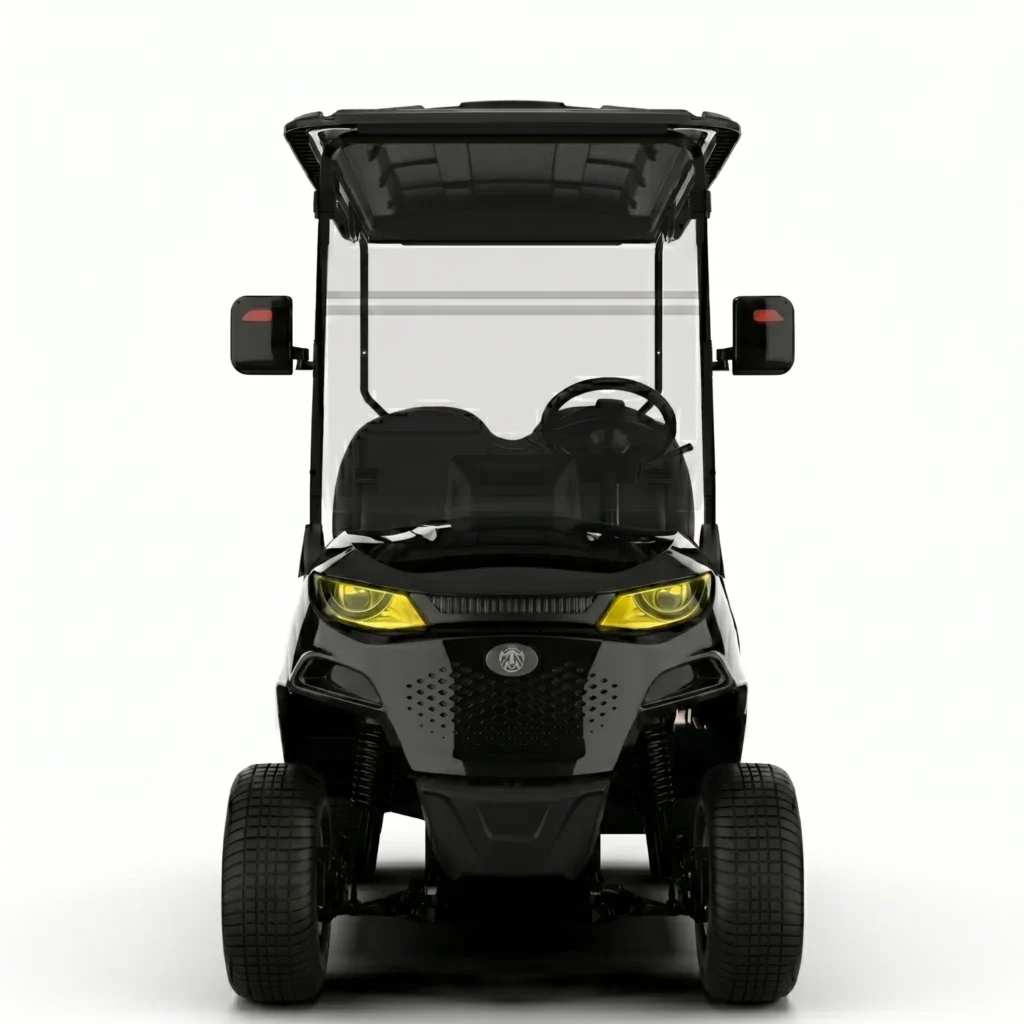
2-seater utility workhorse. Best for solo riders, security patrols, and light utility work.
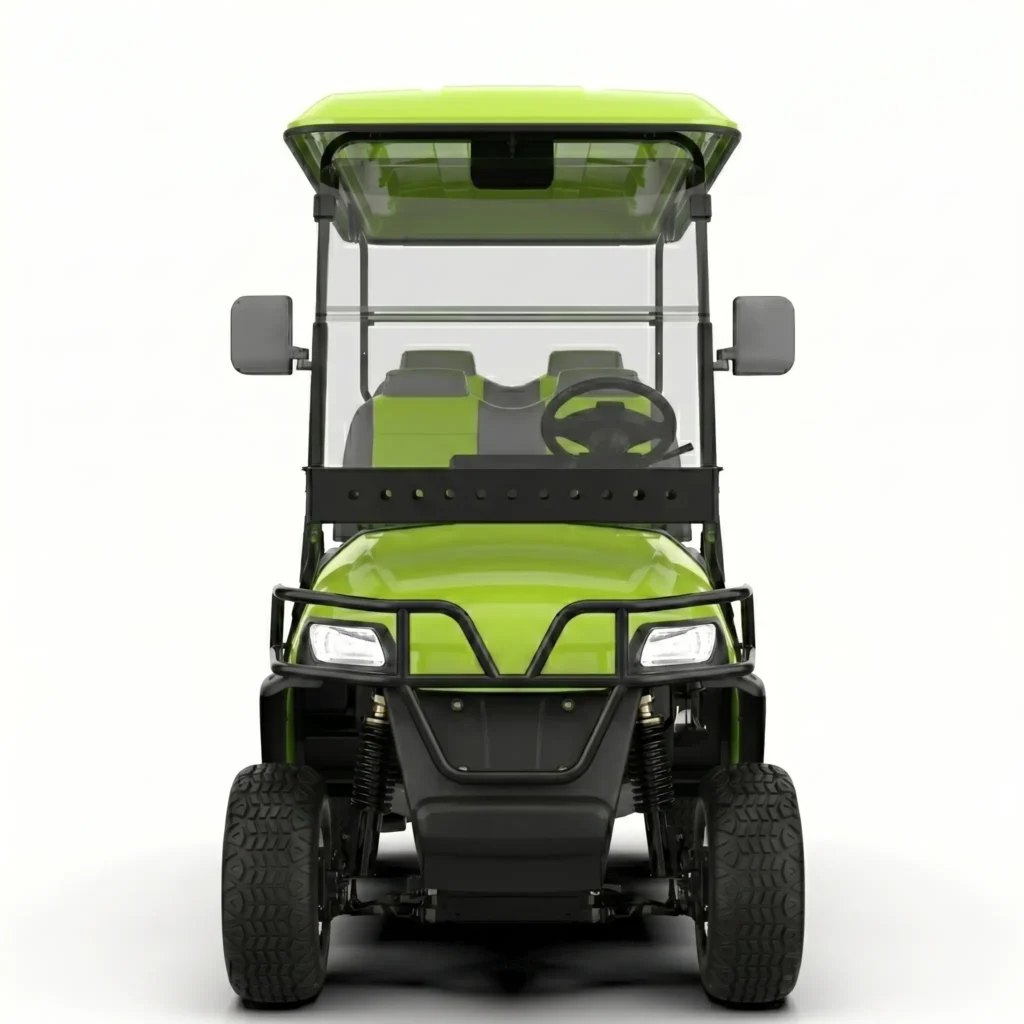
2-seater utility workhorse. Best for solo riders, security patrols, and light utility work.
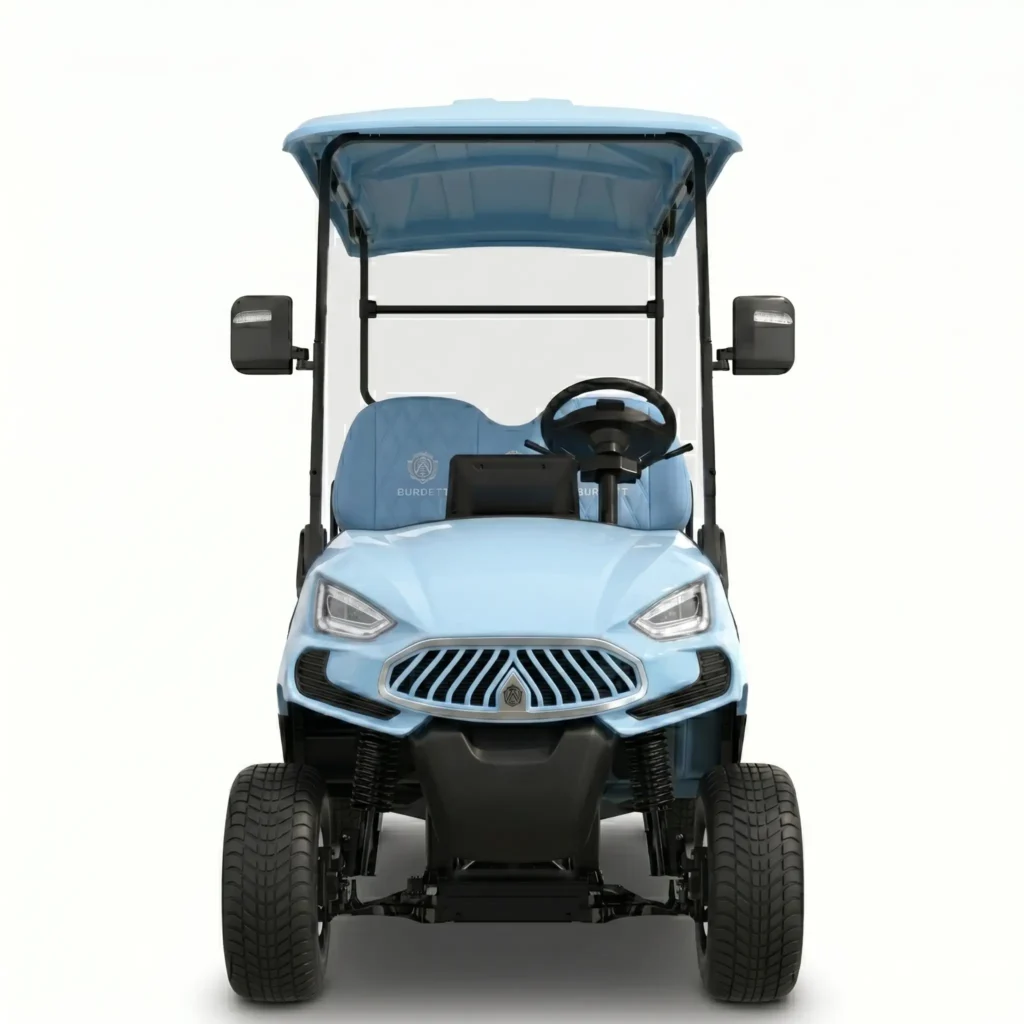
2-seater utility workhorse. Best for solo riders, security patrols, and light utility work.
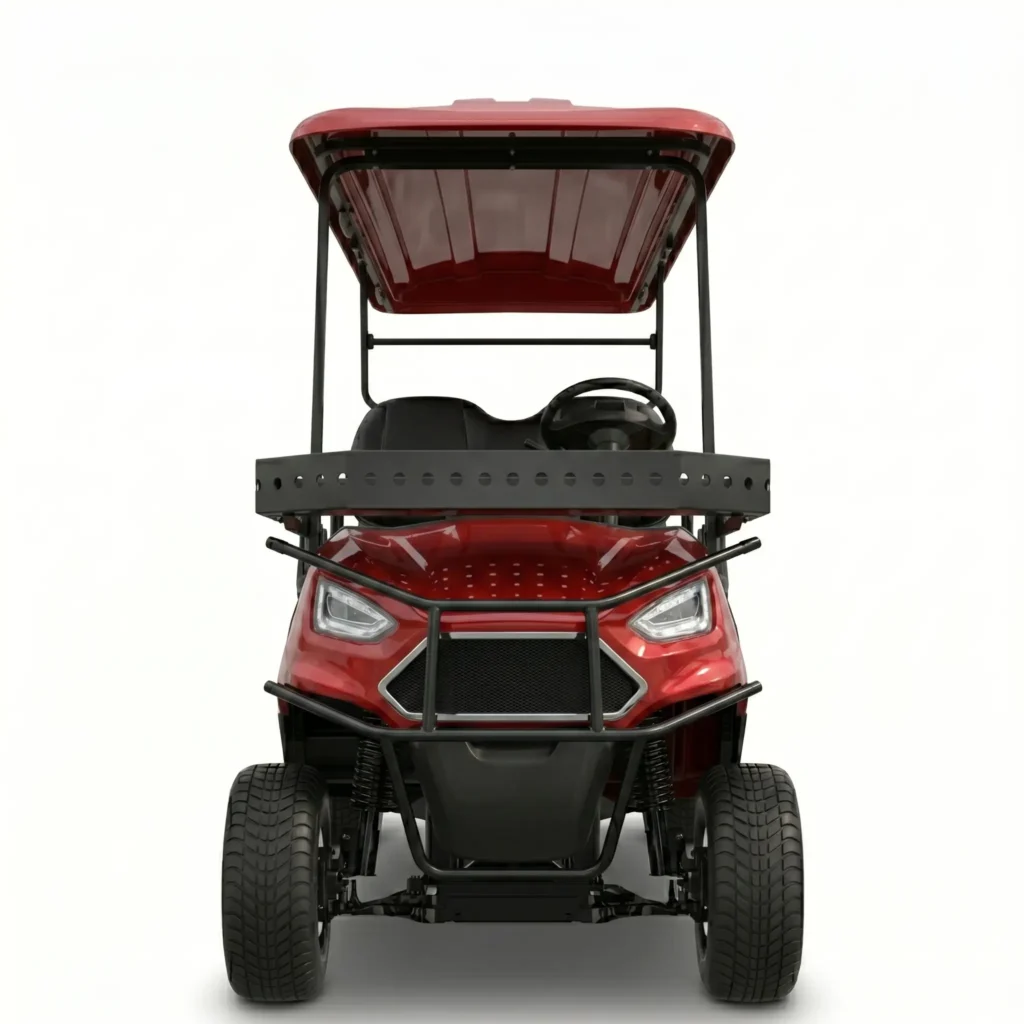
2-seater utility workhorse. Best for solo riders, security patrols, and light utility work.
SUN-CART Products
For 6-seater and 8-seater configurations, SUN-CART offers custom builds through our commercial division, with lead times of 8–12 weeks. Contact our team for a custom quote.
Lorem ipsum dolor sit amet, consectetur adipiscing elit. Ut elit tellus, luctus nec ullamcorper mattis, pulvinar dapibus leo.
Decision Framework: A 5-Question Checklist
Before you commit to a configuration, answer these 5 questions honestly:
- 1
How many people ride in the golf cart on a typical day?
Just me → 2-seat electric golf cart | 1–3 others → 4-seat electric golf cart | 4–5 others → 6-seat electric golf cart | 6+ others → 8-seat electric golf cart
- 2
Where will I drive the electric golf cart most of the time?
Private paths and golf courses → any seating configuration | On-road streets ≤35 mph → choose an appropriate LSV configuration where permitted by local regulations | Resorts and commercial properties → 6-seat or 8-seat golf cart
- 3
What is my realistic golf cart budget?
Under $9,000 → 2-seat golf cart | $9,000–$13,000 → 4-seat golf cart | $13,000–$20,000 → 6-seat golf cart | $20,000+ → 8-seat golf cart
- 4
How much garage or parking space do I have?
Under 10 feet → 2-seat golf cart only | 10–12 feet → 2-seat or 4-seat golf cart | 12–15 feet → 2-seat, 4-seat, or 6-seat golf cart | 15+ feet → any configuration
- 5
How long do I plan to keep the electric golf cart?
1–3 years → 2-seat golf cart | 4–7 years → 4-seat golf cart | 8+ years → 6-seat or 8-seat electric golf cart
Can I add seats to my 2-seater cart later?
Yes, but it’s not recommended. Converting a 2-seater to a 4-seater requires a new rear seat kit ($800–$1,500), upgraded suspension ($600–$1,200), and potentially a new frame reinforcement ($2,000+). Total cost: $3,500–$5,000, which is 70% of buying a new 4-seater.
Are 6-seater golf carts street legal?
In most U.S. states, only forward-facing 4-seater configurations qualify as LSVs. 6-seaters with side-facing third rows are limited to private property. Check your specific state regulations before purchase, especially the FMVSS 500 standard.
Do bigger configurations use more battery?
Yes. A 6-seater uses 15–20% more energy per mile than a 4-seater due to increased weight. Over a year (assuming 1,500 miles), that’s an extra $80–$120 in charging costs.
Can I fit a 4-seater in a standard golf cart garage?
Most 4-seaters are 108–115 inches long. A standard golf cart garage is 10 feet (120 inches) deep. It fits, but with only 5–12 inches of clearance behind the cart.
What's the most popular configuration in 2026?
4-seaters account for 58% of U.S. sales, followed by 6-seaters (22%), 2-seaters (15%), and 8-seaters (5%). The 4-seater has been the #1 configuration for 12 consecutive years.
Should I buy a 6-seater if I only need 4 seats now?
Generally no. The 6-seater costs $4,000–$6,000 more, uses more energy, and is harder to resell. Buy what you need today. If your family grows in 2–3 years, you can sell your 4-seater (which holds 85% of its value) and upgrade.
How much weight can a 4-seater golf cart actually hold?
800–1,100 lbs total payload, including passengers. SUN-CART’s UTV model is rated for 1,100 lbs in 4-seater configuration — 20% higher than the industry standard.
“We sized 95% of our resort fleet to 4-seaters and only added 6-seaters for our airport shuttle contract. Three years in, the 4-seaters have held 86% of their value while the 6-seaters are at 78%. Stick with 4 unless you have a specific commercial use case.”
— Operations Director, 220-room resort in Scottsdale, AZ (SUN-CART customer since 2022)
Final Verdict: Stop Overthinking It
Here’s the 80/20 rule for golf cart seat configuration in 2026:
- 80% of buyers should buy a 4-seater. It’s the safest, most versatile, most resellable configuration.
- 15% of buyers (solo riders, utility users, narrow-path communities) should buy a 2-seater.
- 4% of buyers (resort operators, large families, retirement community fleets) should buy a 6-seater.
- 1% of buyers (commercial shuttle operators) need an 8-seater.
Stop asking “what if I need more seats someday” and start asking “what do I actually do with this cart most days.” The right answer is almost always simpler and cheaper than you think.
Not sure which SUN-CART model fits your needs? Contact our team or request a quote with your use case. We’ll recommend the right configuration based on your daily use, not our inventory.
Ready to Choose Your Configuration?
Talk to a SUN-CART specialist. We’ll match you with the right model in 10 minutes.