Email:dennis@sun-cart.com Whatsapp:+86 13696971344
2026 Golf Cart Industry Trends: From Course Companion to Community Mobility Solution
More Than Just a Golf Course Vehicle
For decades, the golf cart had a single job: carry golfers and their clubs from the 1st tee to the 18th green. That era is over.
In 2026, the humble golf cart has evolved into something far more significant. It’s a legitimate community mobility solution, a cost-effective second car for American families, the backbone of resort logistics, and an essential tool for commercial fleet operations.
The numbers tell the story. The global golf cart market was valued at 2.12billionin2025andisprojectedtoreach2.12billionin2025andisprojectedtoreach3.70 billion by 2034, growing at a CAGR of 6.40%. Across North America, which dominates with nearly 53% of global market share, electric carts now account for approximately 70% of new sales – and that share is climbing rapidly. The global Golf Cart and Neighborhood Electric Vehicle (NEV) market is expected to reach $8.7 billion by 2033, growing at 6.8% CAGR.
What’s driving this transformation? Four powerful trends: the lithium battery revolution, the explosion of street-legal LSV adoption, the expansion beyond golf courses into resorts, communities, and commercial facilities, and the integration of smart technology. This article explores each of these trends and what they mean for buyers in 2026.
The Lithium Battery Revolution – Standard, Not Optional
The Lithium Battery Revolution – Standard, Not Optional
If there’s one trend that defines the 2026 golf cart market, it’s this: lithium batteries have become the new standard.
At the 2026 PGA Merchandise Show, lithium battery systems were positioned as the baseline expectation, not an upgrade. Exhibitors emphasized extended range, reduced charging time, lower maintenance needs, and total cost-of-ownership advantages. The message was clear: lead-acid is fading, and lithium is taking over.
Why lithium is winning:
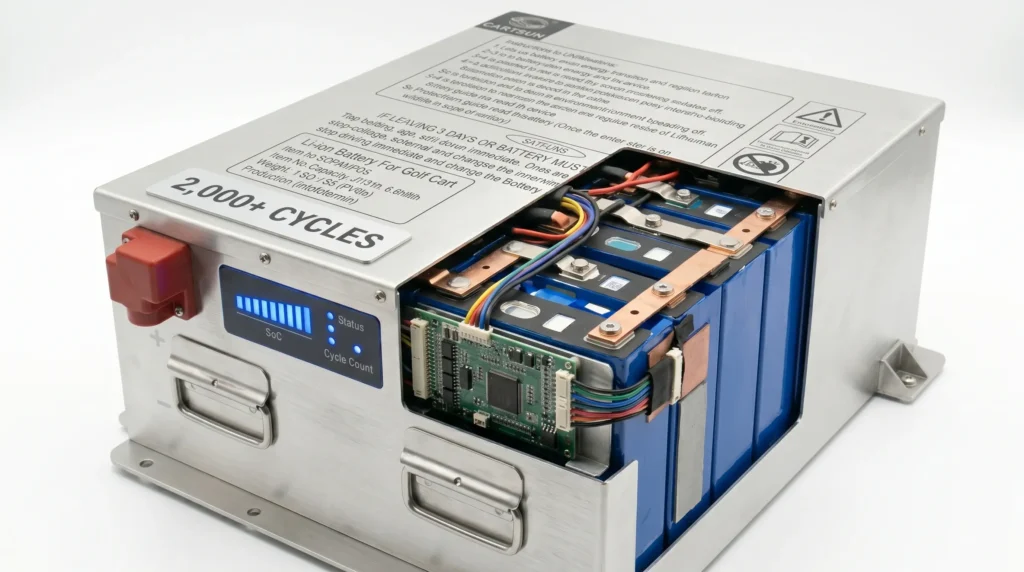
Lead-acid batteries, with their 300-500 cycle lifespan, frequent watering requirements, and terminal corrosion, simply can’t compete with modern LiFePO₄ technology. Lithium batteries now deliver:
| Metric | Lead-Acid | Lithium (LiFePO₄) |
|---|---|---|
| Cycle life | 300-500 cycles | 2,000-5,000 cycles |
| Lifespan | 2-4 years | 8-10+ years |
| Charge time | 8-12 hours | 2-4 hours |
| Weight (48V) | ~280 lbs | ~90 lbs (70% lighter) |
| Maintenance | Monthly watering, cleaning | Zero |
| Energy efficiency | ~75% | 95%+ |
A 48V lithium battery can extend range by over 60% compared to lead-acid systems. For daily-use fleets, the ROI is compelling – lithium typically becomes the more economical choice within 2-3 years.
But 2026 brings even more innovation. Smart Battery Management Systems (BMS) with Bluetooth connectivity now allow real-time monitoring of charge, health, and temperature via smartphone apps. This prevents over-discharge and extends life even in cold climates. For fleet operators, telematics integration provides predictive maintenance alerts, usage analytics, and route optimization – turning a simple battery into a data-generating asset.
Street-Legal LSVs – The Explosion of Neighborhood Mobility
Street-Legal LSVs – The Explosion of Neighborhood Mobility
Perhaps the most transformative trend is the rapid expansion of street-legal Low-Speed Vehicles (LSVs).
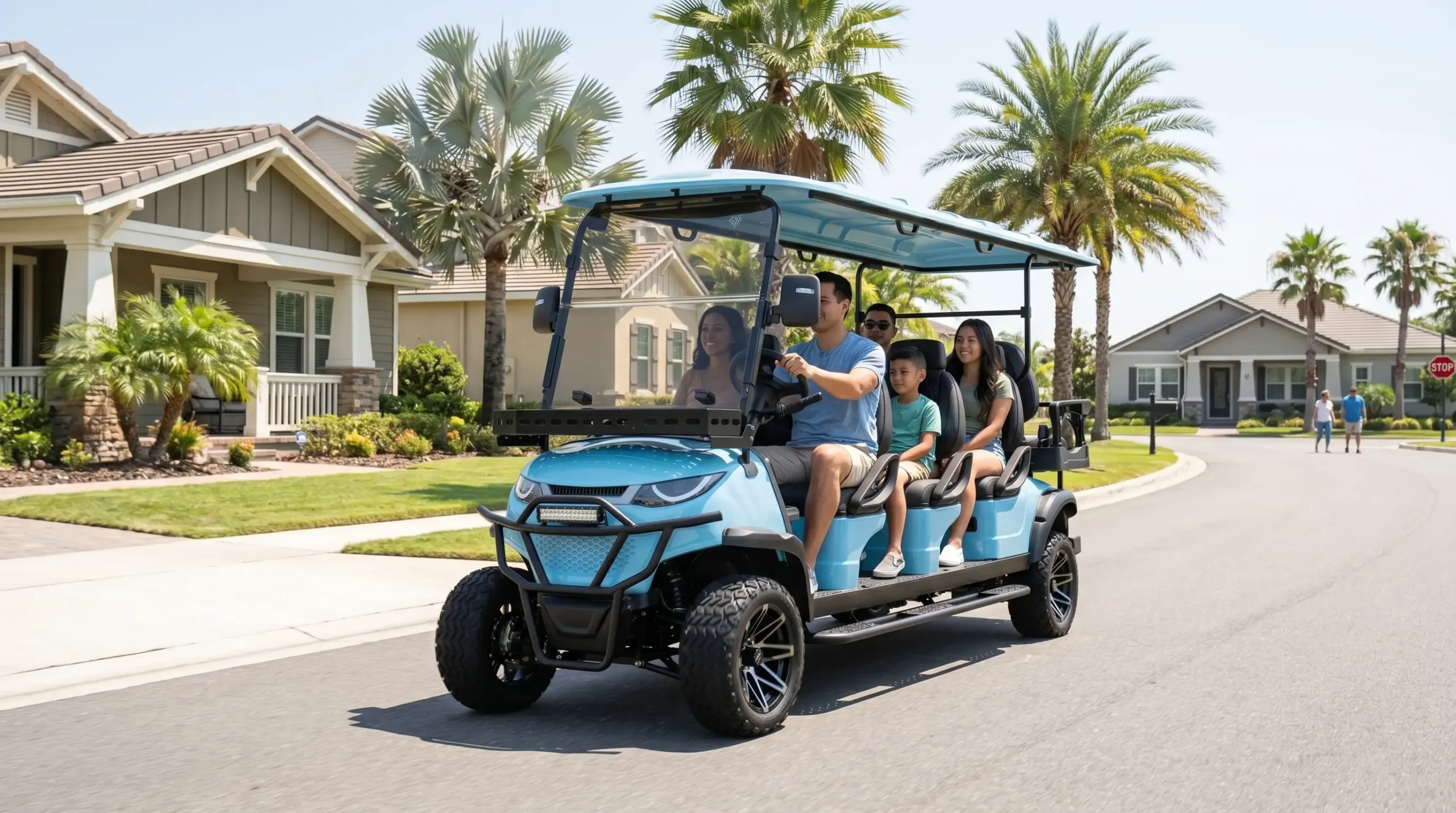
In communities like The Villages in Florida or Peachtree City in Georgia, residents use LSVs for grocery runs, school pickups, visiting neighbors, and virtually every short trip. These vehicles are no longer recreational – they’re primary transportation.
The LSV market is exploding. The street-legal golf cart segment is valued at 525.9millionin2025,projectedtoreach525.9millionin2025,projectedtoreach574.7 million in 2026, and grow to 985.6millionby2032ataremarkable9.38985.6millionby2032ataremarkable9.3819.17 billion by 2035.
Why now?
Several factors are converging. Battery technology has improved range and reliability. Rising car ownership costs – insurance, fuel, maintenance – make LSVs an increasingly attractive second vehicle option. And local governments are updating ordinances to accommodate this shift.
Across the United States, cities are adopting new rules. Galveston, Texas allows golf carts on roads with speed limits of 35 mph or lower if registered with the city. Michigan permits towns under 30,000 population to authorize golf carts on local streets. Michigan’s golf cart and NEV market alone is projected to reach $198 million by 2030, growing at 4.5% annually.
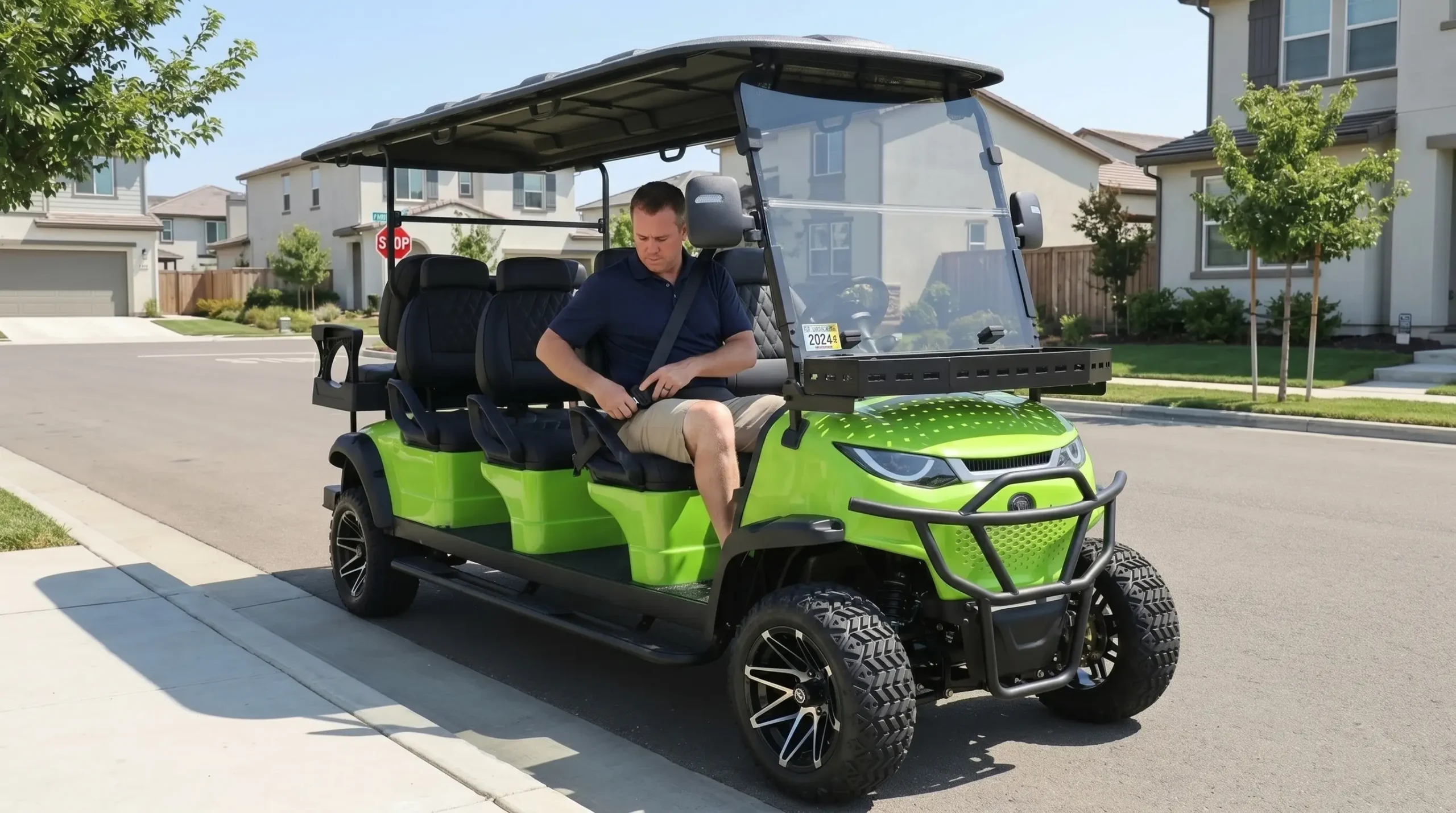
However, there’s a critical distinction that every buyer must understand: A standard golf cart is not street-legal. To operate on public roads, a vehicle must meet federal LSV standards – seat belts, headlights, turn signals, mirrors, windshield, DOT tires, and a 17-digit VIN. An LSV can legally operate on roads up to 35 mph once registered. A standard golf cart cannot.
Beyond the Fairway – Expanding Applications
Beyond the Fairway – Expanding Applications
The golf cart is no longer confined to golf courses. In 2026, these vehicles are finding applications across virtually every sector of the economy.
Resorts & Hospitality
have become major adopters. Resort chains and golf destinations are modernizing fleets with electric carts featuring touchscreen navigation, built-in speakers, and weather protection canopies. Florida and Arizona together account for a substantial share of commercial purchases, driven by tourism and retirement community demand. Hotels use modified carts for luggage transfer, guest shuttling, and event logistics, extending utility far beyond the course.
Residential communities
now represent the second-largest application segment after golf courses themselves. Gated communities, retirement villages, and master-planned developments are building NEV-friendly infrastructure – dedicated paths, compact parking spaces, and low-speed streets – as a selling point for environmentally conscious buyers.
Commercial facilities
are increasingly using electric carts for transporting people and light equipment across convention centers, sports arenas, and industrial complexes. Compact size allows easy navigation through crowded or narrow pathways, while quiet electric operation minimizes disruption during events.
Airports and seaports
rely on LSVs for crew transport, passenger assistance, and facility maintenance. University campuses use them for student and staff shuttles. Industrial parks deploy them for personnel movement and security patrols.
At the 2026 PGA Merchandise Show, exhibitors and buyers referenced growing demand from residential developments, hospitality properties, and mixed-use facilities. As golf-adjacent environments expand, carts are increasingly used for transportation, maintenance, guest services, and security – reinforcing their role as multi-purpose assets.

Smart-Connected-Customizable
Today’s golf cart is a technology platform. The 2026 PGA Merchandise Show highlighted technology integration as a defining theme, with fleet management software, GPS systems, diagnostic tools, and speed-control technologies showcased as solutions enabling operators greater oversight and efficiency.
Smart features now expected:
Integrated GPS with course mapping and geofenced speed control
Bluetooth speakers and USB charging ports
App connectivity for remote battery monitoring
Telematics for predictive maintenance and fleet optimization
For fleet operators, these systems enable real-time monitoring, preventative maintenance planning, and improved safety protocols – increasingly important for facilities managing large or multi-use fleets.
Customization is also driving growth. Lift kits, premium wheels, lighting systems, upgraded seating, enclosures, storage solutions, and sound systems are no longer novelties – they are core components of vehicle programs. Retailers and operators discussed bundled accessory packages designed to increase per-unit value while tailoring carts to specific environments.
Golf course operators and facility managers approached the category with a practical lens, focusing on durability, lifecycle costs, battery performance, maintenance requirements, and safety features. Manufacturers highlighted refinements in chassis design, suspension, braking systems, and weather protection, underscoring how carts are engineered for daily use across varied terrain and climates.
The American Family's "Second Car"
The American Family's "Second Car"
Perhaps the most telling trend is how American families are actually using golf carts.
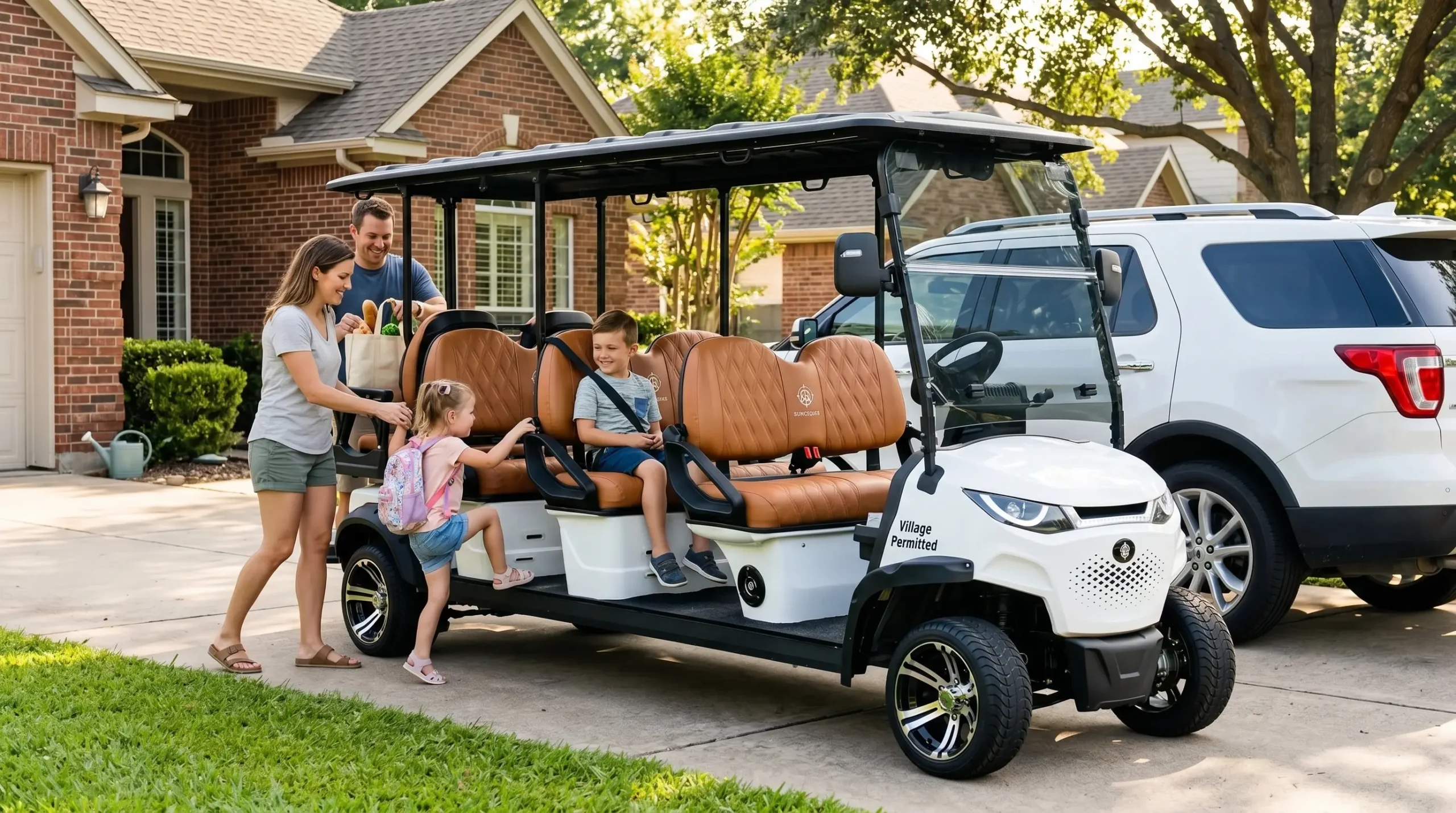
Recent research confirms that daily use, everyday errands, and ownership are the most important variables affecting the choice to use a golf cart as a primary local vehicle. For many families, the golf cart is now used more often than their second car for local travel – trips to the pool, the mailbox, the community center, or a neighbor’s house.
The economics are compelling. A new electric golf cart costs a fraction of a traditional sedan, with significantly lower maintenance and “fueling” costs. With typical top speeds around 20-25 mph, they’re well-suited for short trips – exactly the kind of travel that makes up the majority of daily driving.
Compared to an e-bike, a golf cart offers a more car-like experience with seating for multiple passengers, cargo space, and some level of weather protection. Compared to a full-sized car, an electric cart costs pennies per mile to operate, requires no oil changes, and produces zero emissions.
For gated communities, retirement villages, and planned developments, the golf cart has become something close to an essential appliance – as common as a refrigerator or washing machine.
The Future Outlook – What's Next?
The Future Outlook – What's Next?
Looking ahead, several trends will shape the golf cart industry through 2030 and beyond.
Electric dominance will continue
Electric carts captured an estimated 81.81% of market share in 2025 and are projected to hit 85% in 2026, driven by stringent emission regulations and rising fuel prices.
Lithium costs will continue falling
Battery costs are dropping 5-10% annually, making lithium accessible for mid-range carts. By 2027, experts predict lithium will be the default choice across virtually all price points.
LSV adoption will accelerate
As more states and municipalities adopt golf cart-friendly ordinances, the market for street-legal vehicles will continue its rapid expansion. Expect to see even more local permit programs, simplified registration processes, and designated LSV routes.
Autonomous technology is emerging
Second-generation autonomous patrol platforms are being developed for security and facility management applications, with integrated autonomous patrol capabilities, continuous site monitoring, and real-time communication functionality.
Sustainability will drive innovation
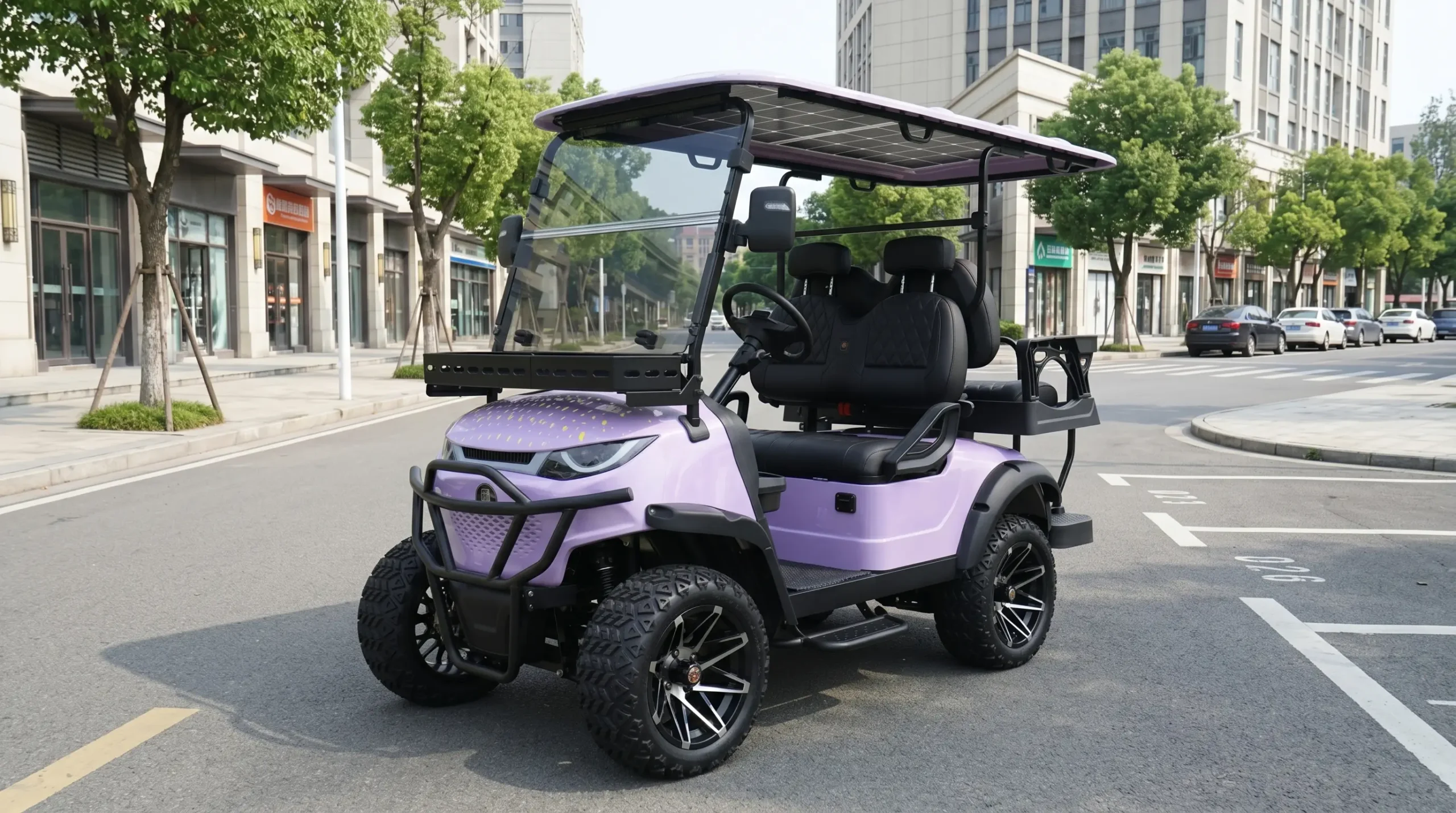
With nearly 60% of travelers prioritizing eco-friendly options, the shift toward zero-emission, quiet electric motors is accelerating. Solar-assisted carts are gaining traction, with integrated panels extending range by 10-20 miles daily.
Conclusion
Conclusion
The 2026 golf cart industry is defined by transformation. Lithium batteries have made electric the obvious choice. LSV regulations have opened streets and neighborhoods. Expanding applications have turned carts into multi-purpose assets for resorts, communities, campuses, and commercial facilities. And smart technology has made them more capable than ever.
For American families, golf carts are becoming the “second car” of choice – a cost-effective, eco-friendly, and convenient solution for daily local travel. For commercial operators, they’re essential tools for guest services, maintenance, security, and logistics.
The question is no longer whether to go electric. It’s how quickly you can capture the benefits.
The golf cart has left the fairway. And it’s not going back.

Newsletter Updates
Enter your email address below and subscribe to our newsletter