Email:dennis@sun-cart.com Whatsapp:+86 13696971344
Gas vs. Electric Golf Cart: Which One Makes Sense for You in 2026?
Why This Decision Matters More Than Ever
You already know golf carts aren’t just for the course anymore. These days, they’re daily drivers in gated communities, essential tools for resort managers, errand runners for families, and even street-legal vehicles for neighborhood commuting.
Which means choosing between gas and electric isn’t some casual decision. It’s a multi-year commitment that affects your wallet, your daily routine, and your peace of mind.
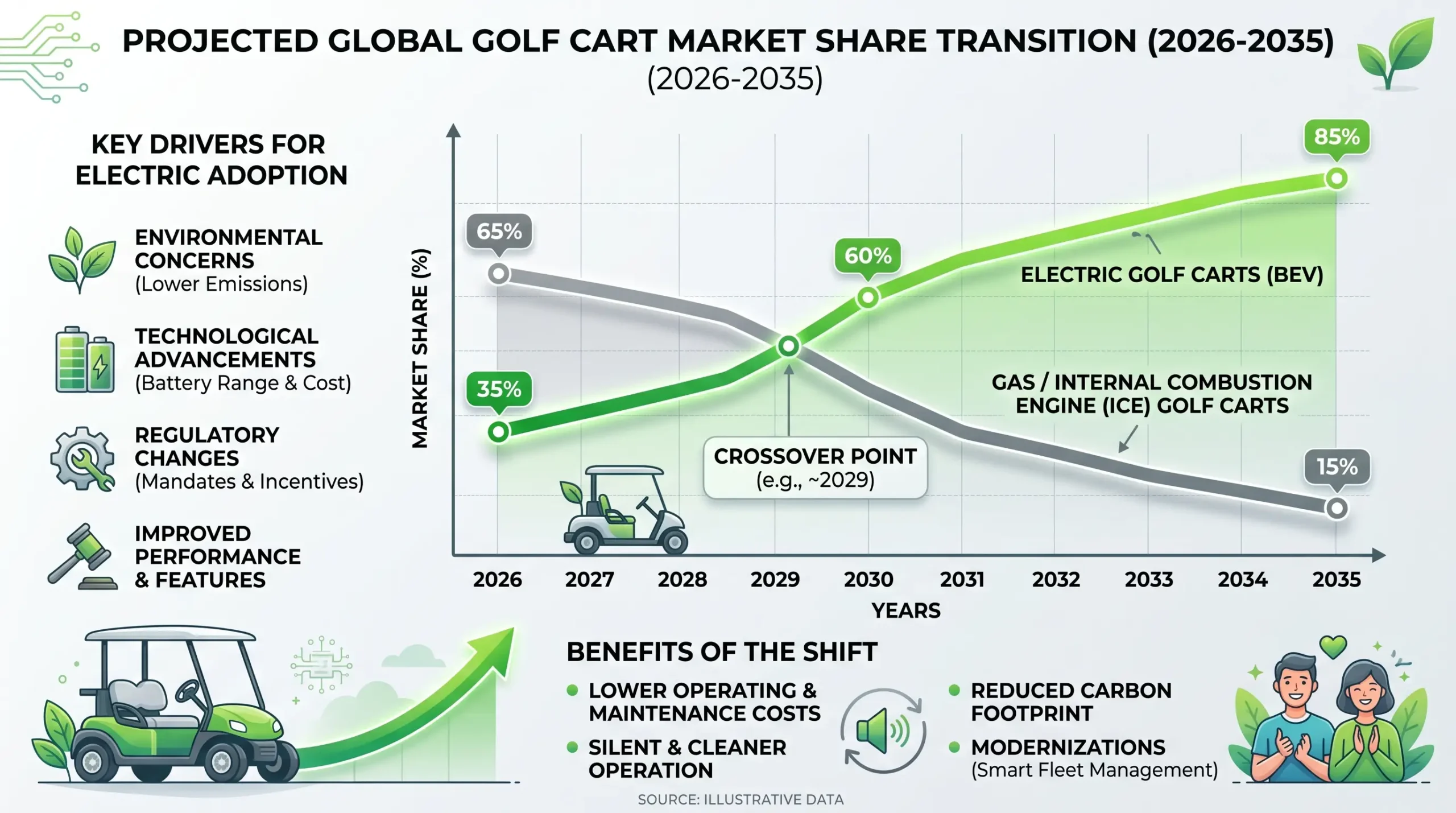
Here’s what’s changed in 2026. Electric golf carts now dominate new purchases — forecast to capture a massive 95.3% of market share, driven largely by their quiet operation and lower running costs. The global electric golf cart market is projected to grow from 1.7billionin2026to1.7billionin2026to3.3 billion by 2035 at a CAGR of 7.9%.
But gas carts haven’t disappeared entirely. They still make sense for certain applications. The key is understanding where and why.
This article breaks down everything that actually matters: real costs, maintenance, driving experience, range, noise, environmental impact, and most importantly — which one fits your actual life.
The Numbers Don't Lie
The Numbers Don't Lie
The market has already spoken. Electric golf cart market share is expected to reach 95.3%, a near-complete industry shift. This isn’t just a trend — it’s a fundamental transition happening now.
By 2026, electric golf carts are expected to capture a commanding 81.64% market share, driven by lower operating costs, silent operation, higher comfort levels and faster speeds.
Meanwhile, the gap between gas and electric purchase prices has narrowed to less than $500 in most regions, making the choice more about lifestyle and long-term value than upfront cost.
The industry has moved decisively toward electric for one simple reason: total cost of ownership for electric golf carts in 2026 is approximately 35% to 45% lower than gas counterparts.
Cost to Buy — Closer Than You Think
Cost to Buy — Closer Than You Think
Let’s start with what you see first. The sticker price.
Entry-level gas carts run 5,000to8,000. Mid-range electric carts fall in the8,000to12,000 range. Luxury and street-legal models start around 12,000andcanexceed12,000andcanexceed20,000 with customizations.
Here’s the thing. At comparable trim levels, the price gap between gas and electric is much smaller than most people expect. For basic carts, electric only costs about 500to500to2,000 more upfront than comparable gas models.
If you add a lithium battery upgrade, add 2,000to2,000to3,500 to the price. But that money buys something significant: zero maintenance, 8 to 10 years of battery life, and consistent power throughout every charge.
The real hidden cost? For gas carts, fuel becomes a constant, unpredictable drain. For electric carts with lead-acid batteries, replacement costs sneak up on you every 3 to 5 years.
Your real total cost of ownership starts after you drive off the lot.
| Cost Factor | Gas Cart | Electric Cart (Lead-Acid) | Electric Cart (Lithium) |
|---|---|---|---|
| Initial Purchase | 5,000–5,000–8,000 | 7,000–7,000–11,000 | 9,000–9,000–14,000+ |
| 5-Year Fuel/Charge | 1,200–1,200–2,500 | 300–300–500 | 150–150–300 |
| 5-Year Maintenance | 1,500–1,500–2,500 | 500–500–1,000 | 100–100–200 |
| Battery Replacement (10 yrs) | N/A | 800–800–1,500 every 4-6 yrs | $0 (once at year 8-10) |
| 10-Year Total Cost | ~11,000–11,000–15,000 | ~10,000–10,000–14,000 | ~9,000–9,000–12,000 |
Based on industry data and average usage patterns
Electric vs Gas
Electric vs Gas
Performance
Gas carts have traditionally held the torque advantage, especially for heavy loads and steep hills. A 13.5 HP Kawasaki engine delivers consistent power for extended climbs in demanding terrain.
But electric technology has closed the gap significantly. Modern electric carts — particularly those with AC motors and 48V or 72V systems — deliver instant torque from a dead stop, offering 100% power the moment you press the pedal.
For 85% of modern users — neighborhood cruising, golf course use, community transport — electric provides more than enough power. On flat, maintained courses, you won’t notice a difference between gas and electric. The electric ride feels smoother and more refined.
On extreme terrain? Heavy hauling up long grades might still favor gas. But the gap narrows every year as battery and motor technology continues to improve.
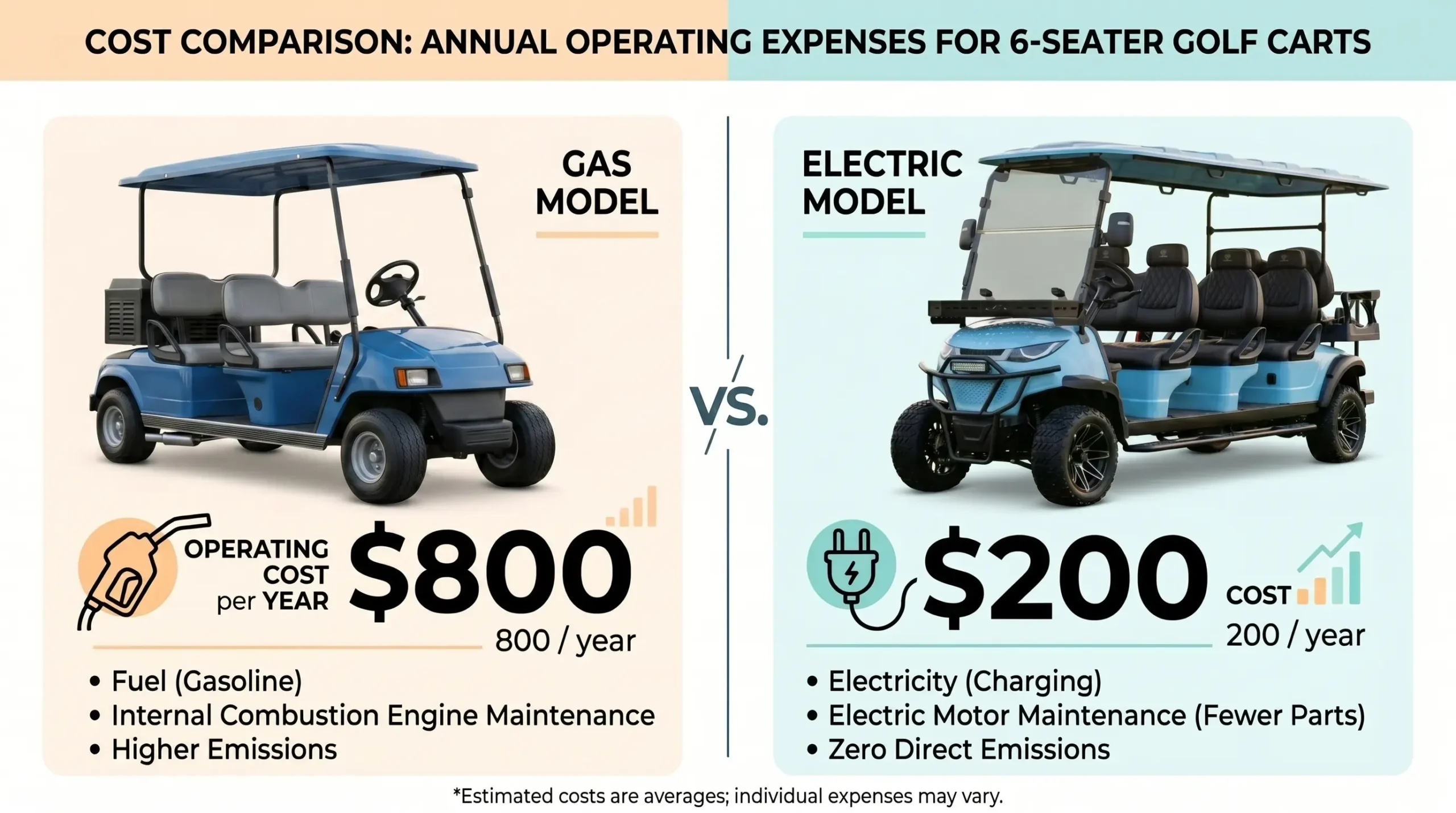
Fuel vs Charging Costs
This is where electric wins decisively. Period.
An electric cart costs just 0.03to0.03to0.05 per mile to charge. A gas cart costs 0.15to0.15to0.25 per mile for fuel.
Over a full year of regular use, you’re looking at roughly 50to50to100 in electricity costs for an electric cart, versus several hundred dollars in gas for equivalent use. As fuel prices have remained unpredictable, the gap has only widened.
For fleet operators running multiple carts daily, these savings compound fast. A 20-cart gas fleet could spend 5,000to5,000to10,000 annually on fuel alone. Electric? Around 1,000to1,000to2,000.
Maintenance — Electric Wins Without Competition
Gas carts need frequent maintenance. Oil changes every 100 to 150 hours. Spark plug replacements. Air and fuel filters. Drive belt adjustments. Carburetor cleaning. Fuel system management.
Electric carts? Minimal. No oil changes. No spark plugs. No fuel filters. No belts. No carburetors. Just battery and brake checks annually.
Over 5 years, the numbers are stark:
Gas cart maintenance cost: 1,500to1,500to2,500
Lead-acid electric cart maintenance: 500to500to1,000
Lithium electric cart maintenance: 100to100to200
Electric owners also recover hours of their time previously spent on maintenance. No driving to gas stations, no scheduling oil changes, no random fuel system failures on Sunday afternoons.
Battery Replacement — The One Real Electric Cost
Let’s be honest about the elephant in the room. Battery replacement is expensive.
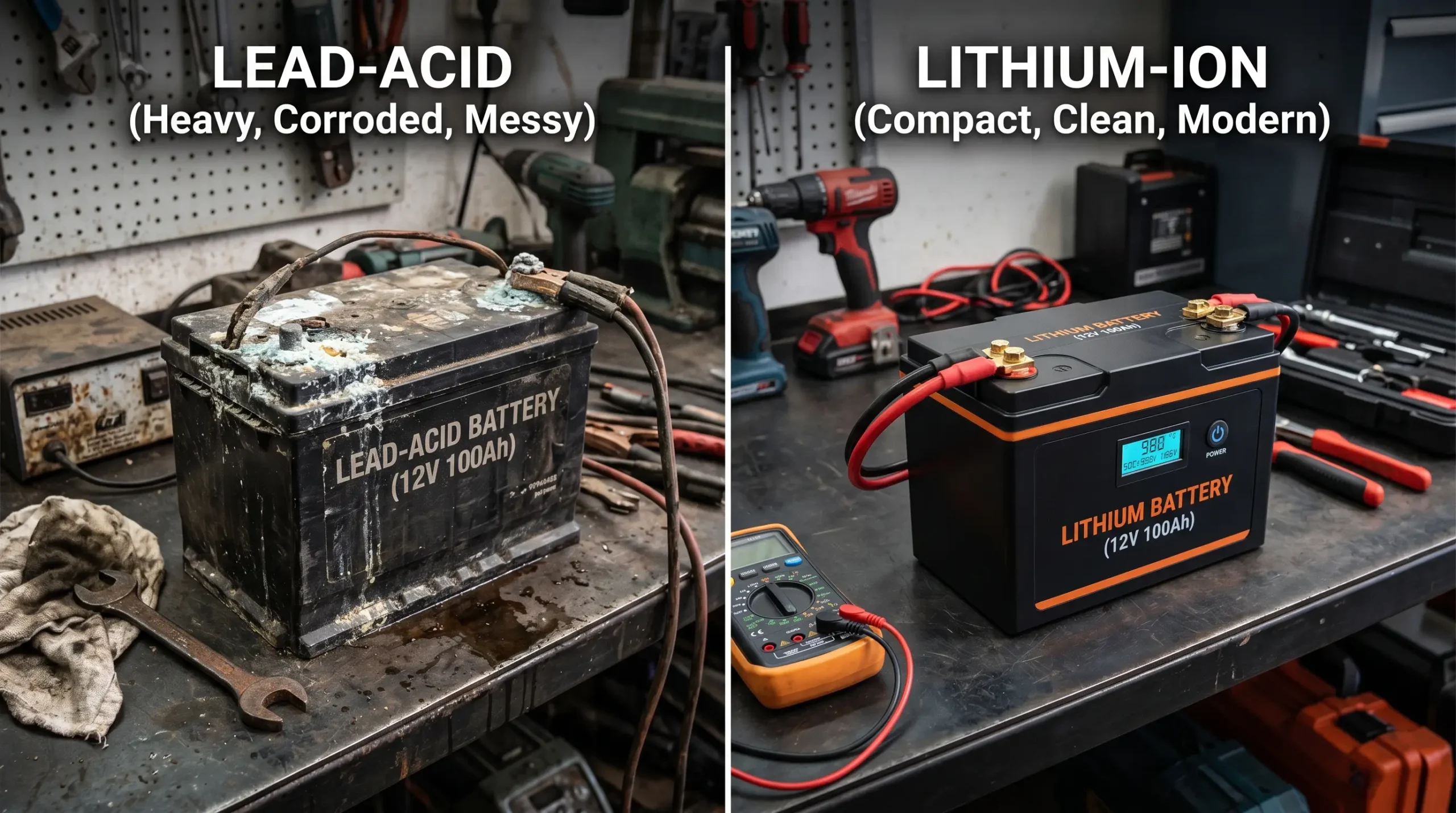
Lead-acid battery sets cost 800to800to1,200 and need replacement every 3 to 5 years. Lithium batteries cost 1,500to1,500to3,500 upfront but last 8 to 12 years — and require zero maintenance in between.
Here’s the math most dealers don’t give you:
Over 10 years, a 48V lead-acid system will cost approximately 2,500+inbatteryreplacements(2−3replacements).Alithiumsystemcosts2,500+inbatteryreplacements(2−3replacements).Alithiumsystemcosts1,500 to $3,500 one time — and then nothing for the rest of the decade.
And lithium batteries pay off even faster for daily users. 8 to 12 years of service life means you may never replace the battery during the entire time you own the cart.
Noise and Emissions
Gas carts produce engine noise that’s especially noticeable in quiet residential communities. Some neighborhoods don’t allow gas carts at all. Many residents simply prefer the peaceful environment that electric provides.
Electric carts operate at approximately 55 decibels, nearly silent. No engine drone. No exhaust fumes drifting through backyards. On shared paths, walkers, runners, cyclists, and parents with strollers all appreciate the difference.
For indoor use — warehouses, convention centers, maintenance facilities — gas isn’t even an option due to emissions. Electric is the only choice.
Range and Refueling
Gas carts can cover serious ground. A 5-gallon tank delivers roughly 100 to 250 miles of travel. When you need to refuel, it takes about 2 minutes at any gas station.
Electric carts have improved significantly. A standard 48V system with lithium batteries delivers 40 to 50 miles per charge — enough for a full day of errands, shuttling, or course use. The 72V high-performance systems stretch to 50 to 65 miles.
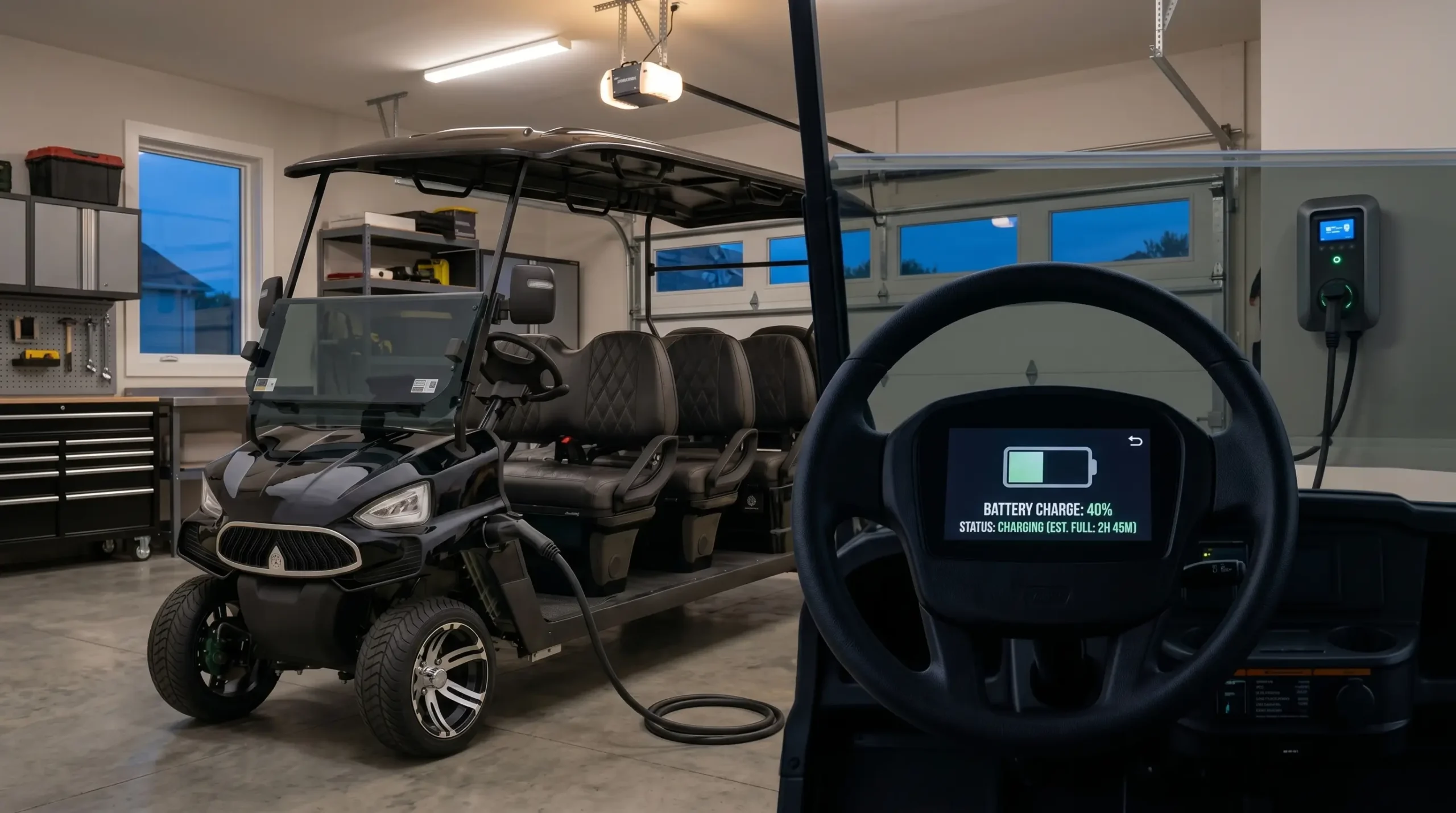
Overnight charging takes 8 to 10 hours, but fast charging can get you to 80% capacity in just 2 to 3 hours. For predictable daily use, electric works perfectly. Fill the charger at night, drive all day. No gas station stops. No fuel price surprises.
The Hidden Story — Most Golf Carts Don't Get Enough Charge Time
Let me share an eye-opening statistic: nearly 60% of cart owners neglect regular maintenance, leading to a 30% reduction in performance lifespan.
But here’s the hidden problem most owners don’t realize until it’s too late: their daily usage patterns don’t match their battery technology.
Here’s what actually happens. Your daily routine changes — a longer errand run, an extra trip to the community center, a new hill you need to climb. Without a consistent overnight charging routine, lead-acid batteries degrade fast. They hate being left at partial charge. They hate deep discharges before recharging. They hate inconsistent charging schedules.
But lithium batteries work the opposite way. They actually thrive on opportunity charging. Run it to 40%, plug it in for an hour, run another trip — no harm, no capacity loss.
For daily drivers — families who use their cart as a second car, commercial operators running multiple shifts — this difference matters enormously. Survey data confirms that daily use, everyday errands, and ownership are the most important variables affecting the choice to use a golf cart as a primary local vehicle.
And here’s the kicker. For many American families, the golf cart is now used more often than their second car for local travel — trips to the pool, the mailbox, the community center, or a neighbor’s house.
That’s not occasional use. That’s daily, mission-critical operation. That needs battery technology that can keep up.
Lithium’s flat voltage curve delivers consistent power whether you’re at 90% charge or 20% charge. No late-day slowdown. No loss of hill-climbing power. No range anxiety before the last errand. That’s a massive performance advantage that spec sheets don’t capture but daily drivers feel immediately.
Why Resorts and Communities Are Already Switching
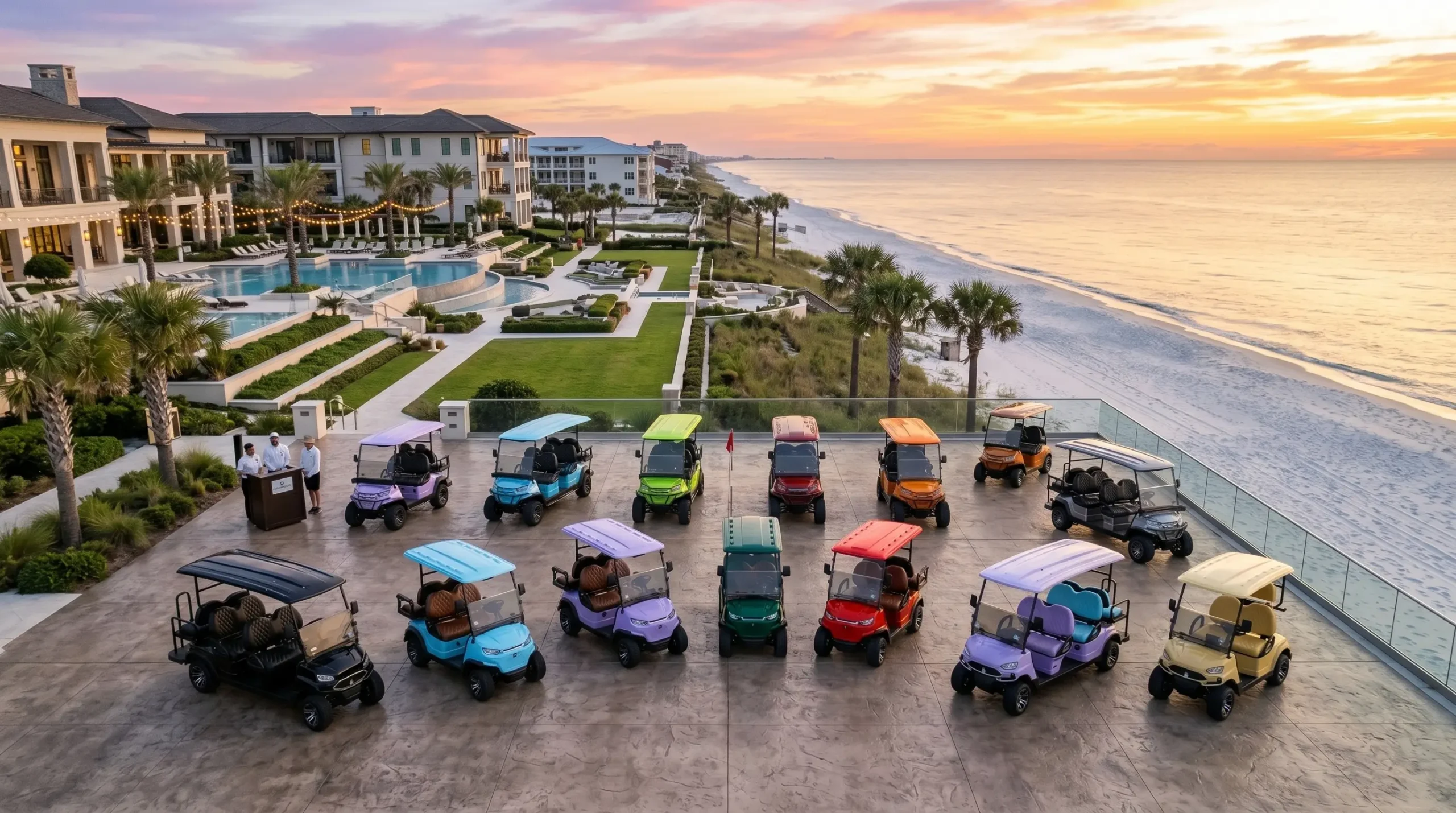
Commercial operators have already made their choice.
For good reason. A 70-cart fleet switching from lead-acid to lithium saves roughly $187,000 over 10 years in battery replacements, electricity, and labor.
Resorts increasingly emphasize guest experience. The nearly silent operation of electric carts creates a peaceful environment — no engine noise across what guests pay for. Today’s guests expect a serene experience, and gas engines disrupt that.
Communities are adopting LSV-friendly infrastructure and recognizing that electric fleets serve residents better with less noise, zero emissions, and dramatically lower maintenance requirements.
Plus, when resorts and HOAs place custom branding on a uniform lithium-powered fleet, it sends a clear signal: this is a modern, forward-thinking organization. Gas fleets look outdated by comparison.
Street Legal Requirements — The LSV Advantage
If you plan to drive on public roads, this changes everything.
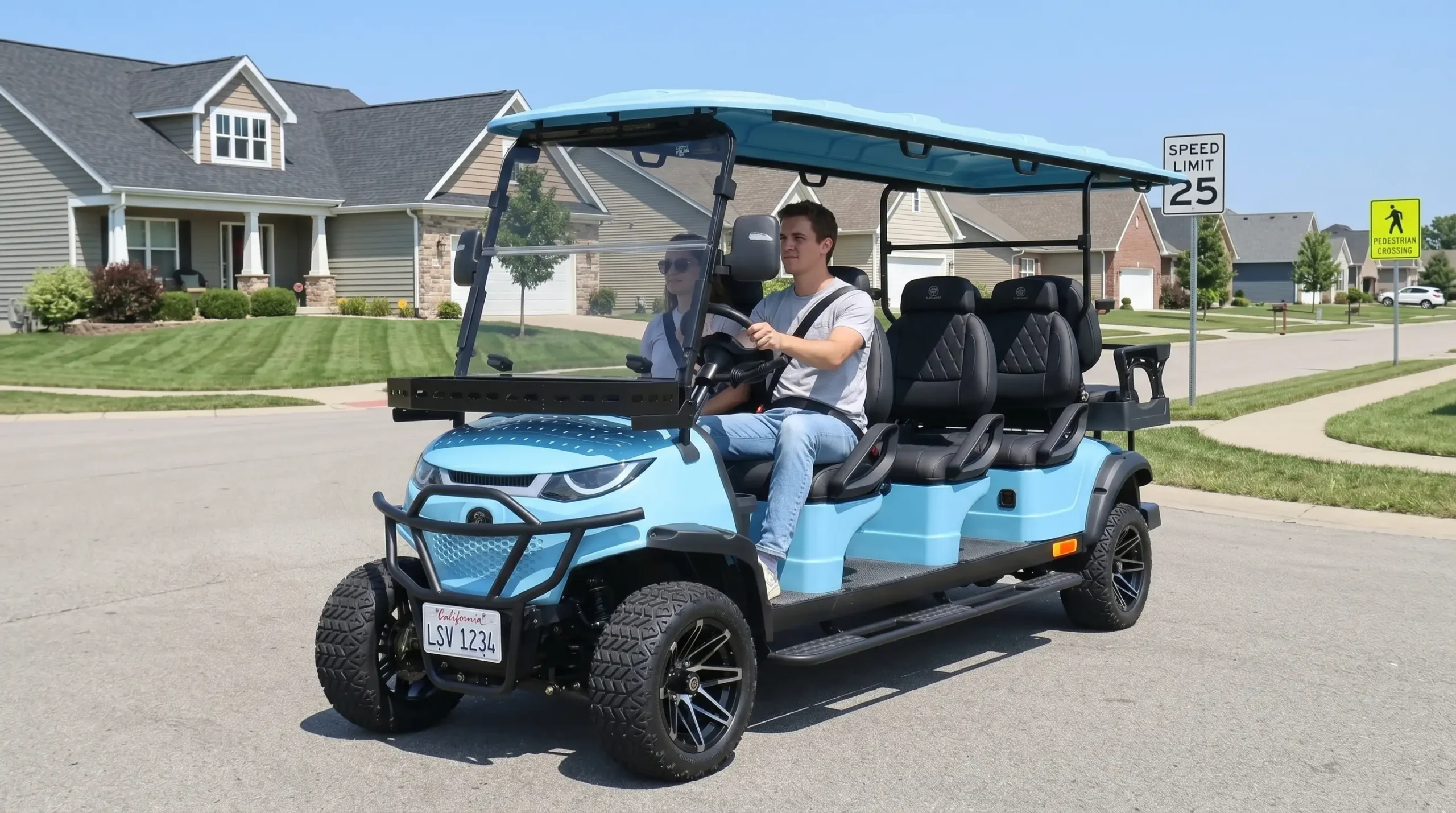
A basic golf cart isn’t legal for street use. A Low-Speed Vehicle (LSV) requires specific safety equipment: seat belts, headlights, turn signals, mirrors, windshield, VIN number, and DOT-approved tires.
Gas carts can’t easily meet these requirements. They’re still considered off-road vehicles.
Electric carts can be designed from the ground up as LSVs. Sun-Cart models come LSV-certified, ready to register with your local DMV, and legal on roads with speed limits up to 35 mph.
Therefore, if you want a street-legal cart — for neighborhood errands, community shuttling, or property management — electric is the clear choice. Gas carts simply aren’t designed for this.
How to Make the Right Choice for You
Here’s my guidance for different use cases:
For Daily Neighborhood Driving: Choose Electric Lithium
Neighbors appreciate the quiet. You’ll do no maintenance. And you’ll drive past gas stations, not stop at them. The consistent power means late-day errands feel as peppy as morning trips.
For Golf Courses: Choose Electric
Most courses run all-electric fleets now. The nearly silent operation respects other players. Overnight charging fits perfectly into course operations. And players expect modern, quiet carts.
For Resorts and Hospitality: Choose Electric Lithium with Custom Branding
A branded, modern-looking lithium cart fleet becomes part of your property’s visual identity. It reinforces messaging around quality, sustainability, and guest experience — all at a lower operating cost than gas alternatives.
For Remote Properties Without Reliable Charging: Consider Gas
Gas carts can still make sense if you lack charging infrastructure entirely and refueling is easier than setting up electrical service. For heavy hauling on extreme terrain with no access to power, the old technology still works.
But for the majority of suburban homeowners, community operators, and golf courses — electric, particularly lithium, is simply the better long-term choice.
How to Choose the Right Battery Type for Electric
If you’ve decided on electric, you still need to decide between lead-acid and lithium.
Lead-Acid may work if:
You drive only occasionally (once or twice a week)
You’re on a tight budget and can’t afford the initial lithium premium
You’re comfortable with monthly watering and terminal cleaning
You don’t mind replacing batteries every 3 to 5 years
Lithium makes sense if:
You drive daily (most US families in golf cart communities)
You want zero maintenance — just plug in and go
You care about consistent hill-climbing power throughout the day
You plan to keep your cart for 5+ years
You want a higher resale value when you sell
Lithium systems generally cost 1,500to1,500to3,500 upfront but last 8 to 12 years — you may never replace the battery. The 5-year ROI analysis shows lithium becomes more economical after just 2 to 3 years for daily-use vehicles.
Which is cheaper to maintain, gas or electric?
Electric, by a wide margin. Gas carts need oil changes, spark plugs, filters, and fuel system service. Electric has almost no routine maintenance beyond tire pressure checks and brake inspections. Even with eventual battery replacement factored in, electric still wins on 5 and 10-year cost comparisons.
How far can an electric golf cart travel on a single charge?
With lithium batteries and a 48V system, expect 40 to 50 miles per charge. A 72V system extends range to 50 to 65 miles. That’s sufficient for full days of errands, shuttling, or course operations.
Are electric golf carts street legal?
Only if LSV-certified with seat belts, headlights, turn signals, mirrors, windshield, VIN, and DOT tires. Sun-Cart models come fully certified. A basic golf cart is not street legal.
Are gas or electric golf carts better for hilly terrain?
Gas carts traditionally had the advantage, but modern lithium-powered electric carts have closed the gap significantly. A 72V lithium system delivers 30% gradeability — enough for most residential and course applications. For extreme off-road use, gas still holds the edge.
How long do golf cart batteries last?
Lead-acid batteries last 3 to 5 years. Lithium (LiFePO₄) batteries last 8 to 12 years and require zero maintenance in between. Lithium batteries are the better long-term investment for daily drivers.
What's the warranty on the battery?
Sun-Cart LiFePO₄ batteries come with a 5-year warranty — full replacement coverage with US-based support.
The Future Is Electric
The data is decisive. For residential neighborhoods, commercial fleets, golf courses, and resorts, electric golf carts make more financial and operational sense in 2026.
Lower total cost of ownership. Zero emissions. Nearly silent operation. Minimal maintenance. Street-legal LSV options. And the technology only continues to improve.
The one exception? Remote properties without reliable charging infrastructure or extreme off-road terrain where gas may still have a place.
But for the vast majority of American families and business operators — particularly those in gated communities, resort management, and course operations — the choice is clear. Electric wins.
Not because gas carts are bad. Because the total cost, driving experience, and long-term value simply point one direction.
Lithium-powered electric golf carts aren’t just the future. They’re what smart buyers choose right now.
Get the latest information on our products
/ solutions that meet your needs
Get the latest information on our products / solutions that meet your needs
Newsletter Updates
Enter your email address below and subscribe to our newsletter