Email:dennis@sun-cart.com Whatsapp:+86 13696971344

2026 Electric Golf Cart Outlook: Tariffs, AI Trends & Lithium Technology Reshape a USD 3.3 Billion Market
The Electric Golf Cart Market Enters a New Era
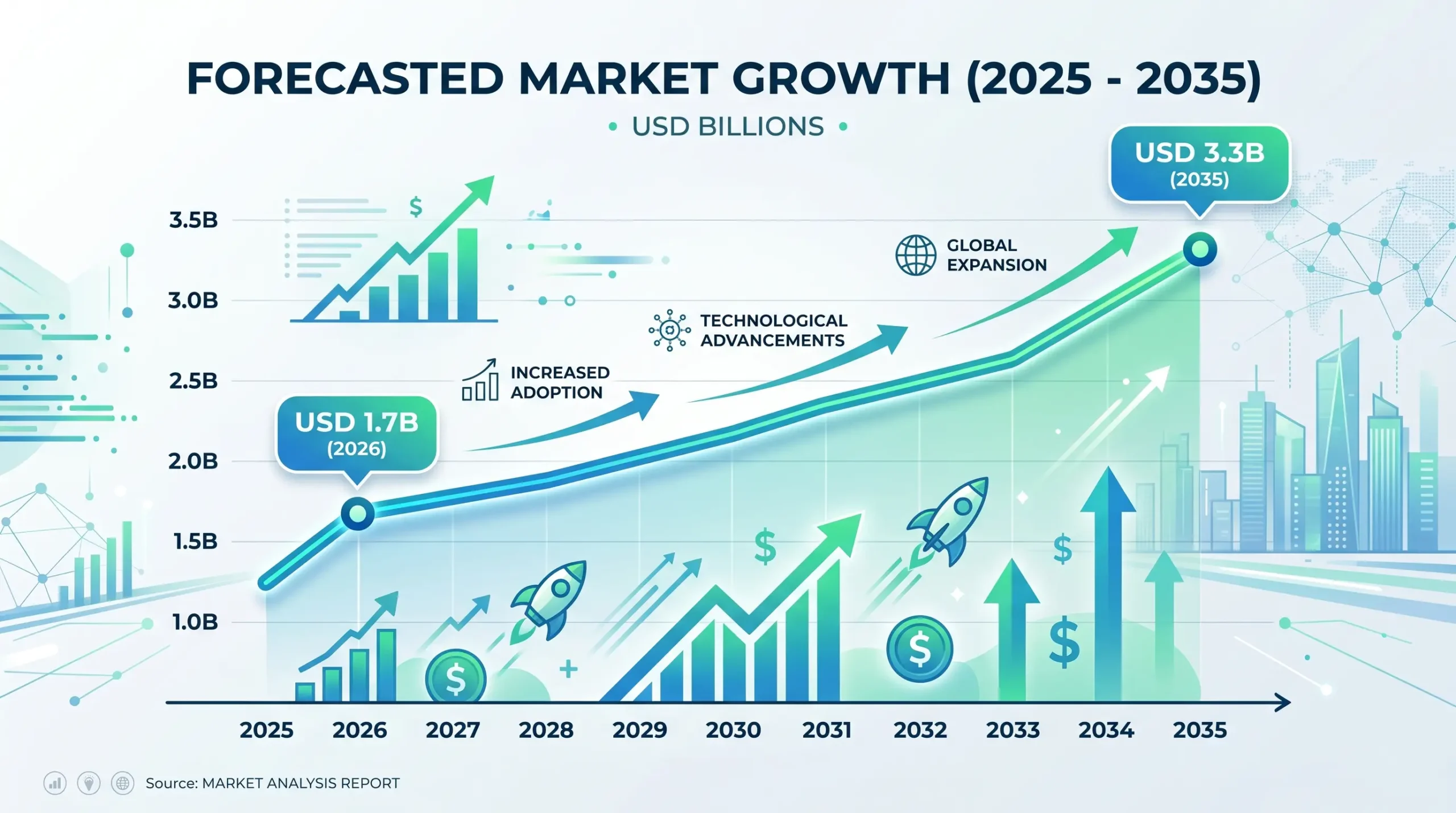
The global electric golf cart market is undergoing its most dramatic transformation in decades. Industry data shows a market valued at USD 1.7 billion in 2026 is projected to reach USD 3.3 billion by 2035, growing at a CAGR of 7.9%. But beyond the growth numbers, three seismic shifts are reshaping the entire industry.
First, a major U.S. tariff crackdown on Chinese-manufactured golf carts is fundamentally altering supply chains and market access. Second, the rapid adoption of AI and smart fleet technology is transforming electric golf carts from simple vehicles into intelligent mobility platforms. Third, lithium battery technology has finally crossed the tipping point from “premium upgrade” to “industry standard.”
For B2B buyers—resort operators, community managers, golf course owners, and commercial fleet managers—understanding these trends isn’t just about staying informed. It’s about making smarter purchasing decisions that could save hundreds of thousands in total cost of ownership over the next five years.
This article breaks down what you need to know about tariffs, what AI actually means for your fleet, and why 2026 is the year lithium batteries become the obvious choice.
Where the Industry Stands in 2026
Where the Industry Stands in 2026
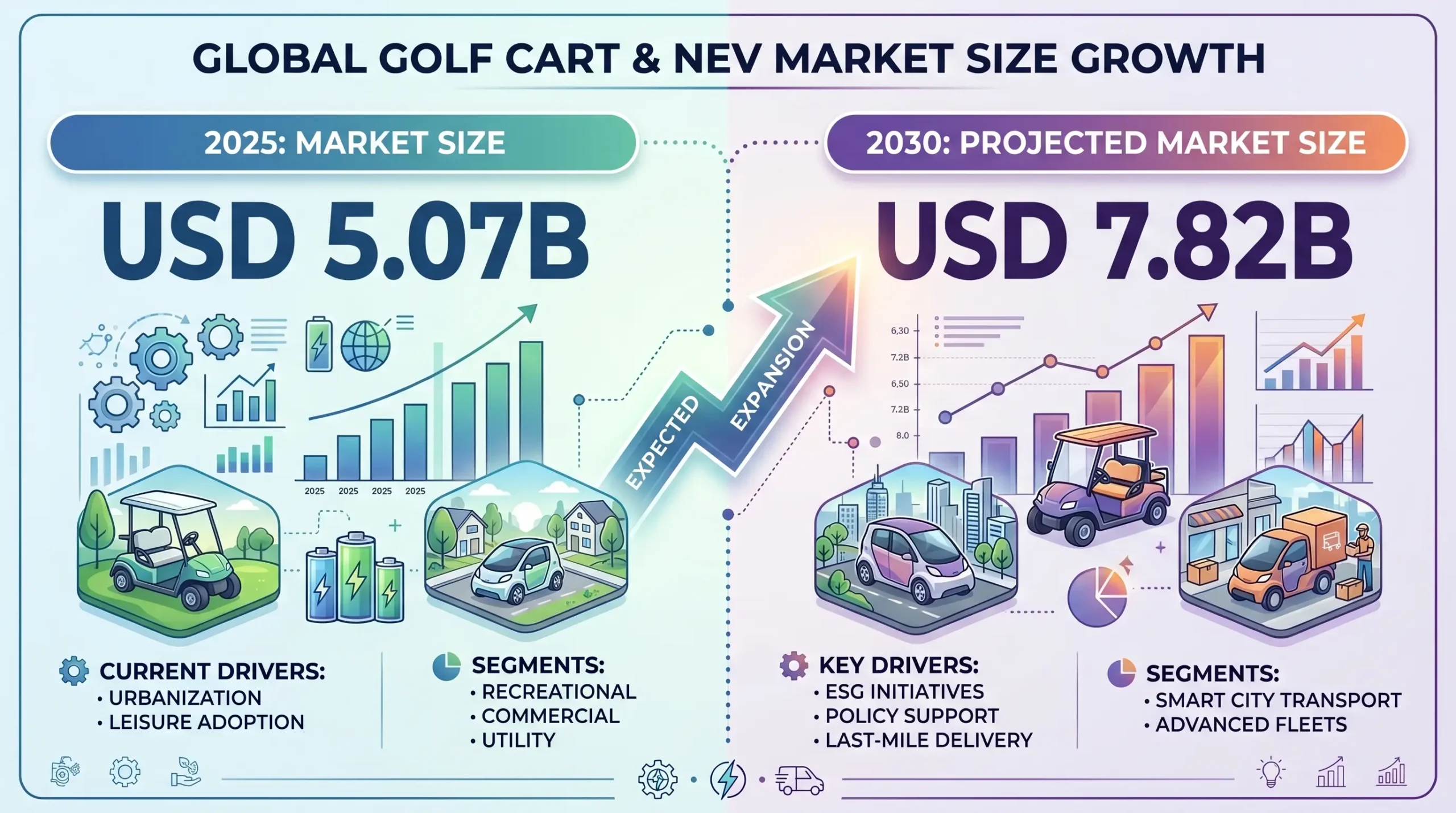
The numbers paint a picture of unprecedented growth. The global electric golf cart market is expected to grow from 2.28billionin2026to2.28billionin2026to3.39 billion by 2030, a CAGR of 10.5%. The broader Golf Cart and Neighborhood Electric Vehicle (NEV) market, which includes personal transport vehicles used in communities and campuses, was valued at 5.07billionin2025andisprojectedtoreach5.07billionin2025andisprojectedtoreach7.82 billion by 2030 at a CAGR of 9.2%.
Lithium battery market growth is even more dramatic—projected to grow from USD 705.1 million in 2026 to USD 2.1 billion by 2035 at a CAGR of 12.8%. The lithium advantage is undeniable: higher charge current, extended cycle life, reduced weight, and minimal maintenance all enhance vehicle performance and lifecycle economics.
What’s driving this expansion? Three interconnected forces:
Expanding applications beyond golf courses: Golf carts now serve resorts, airports, industrial campuses, warehouses, and smart cities for short-distance mobility.
Government initiatives promoting zero-emission vehicles: The UK alone saw 410,000 new zero-emission vehicle registrations in 2024, up 20% from 2023.
Lithium-ion batteries replacing lead-acid at an accelerating pace: This transition is a major market growth driver, fundamentally changing fleet economics.
For B2B fleet managers, the implications are straightforward: electric golf carts are no longer a niche product for golf courses—they’re a mainstream mobility solution. But market growth alone doesn’t tell the whole story.
The Tariff Earthquake: How U.S. Trade Actions Are Reshaping the Market
The Tariff Earthquake: How U.S. Trade Actions Are Reshaping the Market
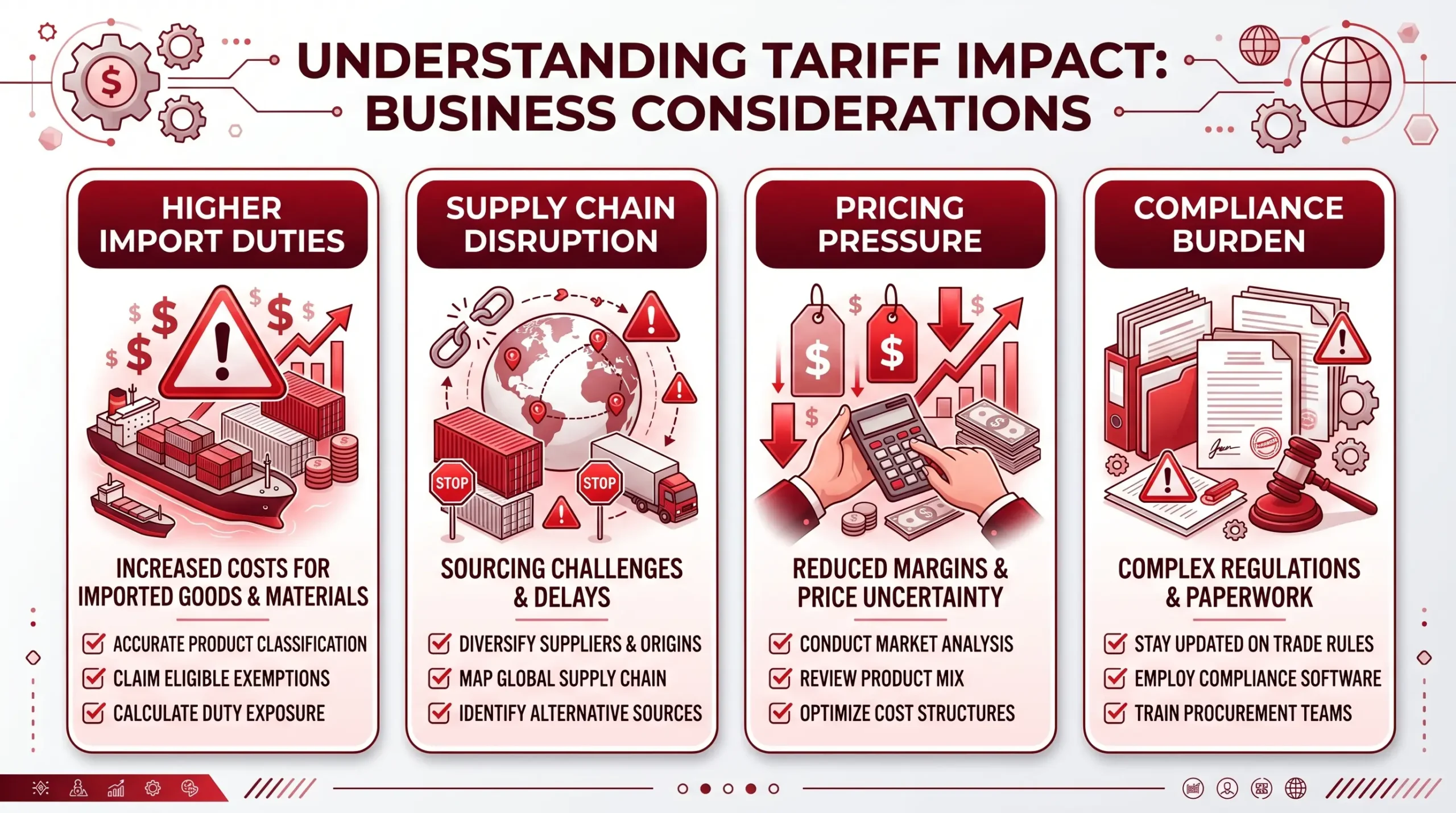
On March 30, 2026, the U.S. Customs and Border Protection (CBP) dropped a bombshell on the golf cart industry. Acting under the Enforce and Protect Act (EAPA), CBP launched an investigation into Chinese-manufactured Low-Speed Personal Transportation Vehicles (LSPTVs)—encompassing golf carts, personal transportation vehicles, low-speed vehicles, and light utility vehicles—alleging widespread evasion of anti-dumping and countervailing duties.
The impact was immediate and severe. Twelve major U.S. importers were named, including ICON EV LLC, Denago EV Corporation, Tao Motor Inc., and other major players. Denago and Evolution—two of the largest Chinese LSPTV brands in the U.S. market—were directly implicated. The tariffs already facing Chinese-made golf carts and related vehicles range from 100% to over 600%, triggered by complaints from U.S. manufacturers Club Car and E‑Z‑GO about “unfair competition”. CBP determined there was reasonable suspicion that covered merchandise from China was being transshipped through Vietnam to evade duties. As a result, targeted importers must now:
Submit “live entry” for all imports, meaning proper documentation and duties must be paid before goods are released.
Face suspended or extended entries without final duty computation.
Undergo continuous bond reviews and potential single-transaction bond requirements.
What this means for buyers:
| Effect on the Market | Impact Description |
|---|---|
| Soaring Compliance Costs | Targeted importers face massive escrow deposits, crippling cash flow and raising end-user prices |
| Supply Chain Disruption | Cargo is frequently held, inspected, or returned, leading to unpredictable delivery times |
| Market Share Shift | Chinese brands face significant price hikes and inventory shortages; U.S. manufacturers (Club Car, E‑Z‑GO) gain advantage |
Sun-Cart’s Position: While many manufacturers have been caught off guard, Sun-Cart has always maintained proper compliance protocols. Our commitment to transparent documentation, proper tariff classification, and ethical trade practices means we continue serving North American customers with reliable delivery timelines and predictable pricing. We are actively monitoring these developments and working with logistics partners to ensure our supply chain remains resilient.
Actionable Takeaway for B2B Buyers: If you’re sourcing electric golf carts for your resort, community, or fleet, verify your supplier’s compliance status before signing any contracts. Look for manufacturers with established compliance histories—not those scrambling to adjust after being caught off guard.
The AI Revolution: What 'Smart Golf Carts' Actually Mean for Your Fleet
The AI Revolution: What 'Smart Golf Carts' Actually Mean for Your Fleet
Artificial intelligence is moving from automotive luxury features into mainstream electric golf cart technology—and the implications for fleet management are substantial.
Autonomous Patrol Platforms Are Here
In April 2026, Massimo Motor announced the ongoing development of its second-generation autonomous patrol golf cart platform. Unlike earlier models focused on basic transportation, this next-generation system is being designed with integrated autonomous patrol capabilities, continuous site monitoring, and real-time communication functionality. The platform is intended to support extended-duration or continuous patrol operations, with the ability to transmit alerts and operational data directly to designated personnel via mobile-connected systems. Massimo believes these features may enhance situational awareness, improve response times, and support more efficient security and facility management operations, with potential applications across manufacturing facilities, commercial properties, campuses, parks, and logistics sites.
AI-Enabled Fleet Upgrades Are Accelerating
Also in April 2026, Massimo Group (Nasdaq: MAMO) announced a strategic partnership with Shenzhen AIBO Robotics to advance intelligent commercial automation and AI-enabled system upgrades for its golf cart and related vehicle platforms. Areas under evaluation include:
Assisted or semi-autonomous navigation
Obstacle detection
Route management
Remote monitoring
Environment-aware alert functions
MAMO plans to evaluate deployment opportunities across high-frequency, labor-sensitive, and standardized environments, including managed-site mobility solutions, hospitality settings, and industrial service scenarios. This reflects a massive industry shift: electric golf cart manufacturers are increasingly positioning themselves as total mobility solution providers, not just vehicle assemblers.
What This Means for Your Fleet Management
| Smart Feature | Practical Benefit for Fleet Operators |
|---|---|
| Real-time GPS tracking | Know every cart’s location across your resort, campus, or community at all times |
| Geofencing | Automatically restrict carts from entering sensitive areas—protect turf, reduce liability |
| Predictive maintenance alerts | Prevent breakdowns before they happen; reduce unexpected downtime |
| Usage analytics | Optimize fleet size and deployment based on actual usage data, not guesswork |
| Remote diagnostics | Troubleshoot issues without dispatching technicians—faster resolution, lower costs |
The global market for AI-powered mobility solutions is expanding rapidly. The service robotics market—within which security and patrol robotics are a rapidly growing segment—is already in the multi-billion-dollar range and expected to grow at an accelerated pace, driven by labor shortages, rising operating costs, and increasing interest in technology-enabled security and site management systems across the United States.
Sun-Cart’s Position: Sun-Cart electric golf carts are equipped with FOC smart controllers featuring CAN bus communication, enabling seamless integration with third-party fleet management and telematics systems. Our vehicles are designed to be smart-technology ready, providing the infrastructure needed to incorporate AI-driven features as they become available.
The Lithium Tipping Point: Why 2026 Is the Year to Switch
The Lithium Tipping Point: Why 2026 Is the Year to Switch
The data is unequivocal: lithium battery technology has finally become the default choice, not just an expensive upgrade.
The Lithium Advantage: By the Numbers
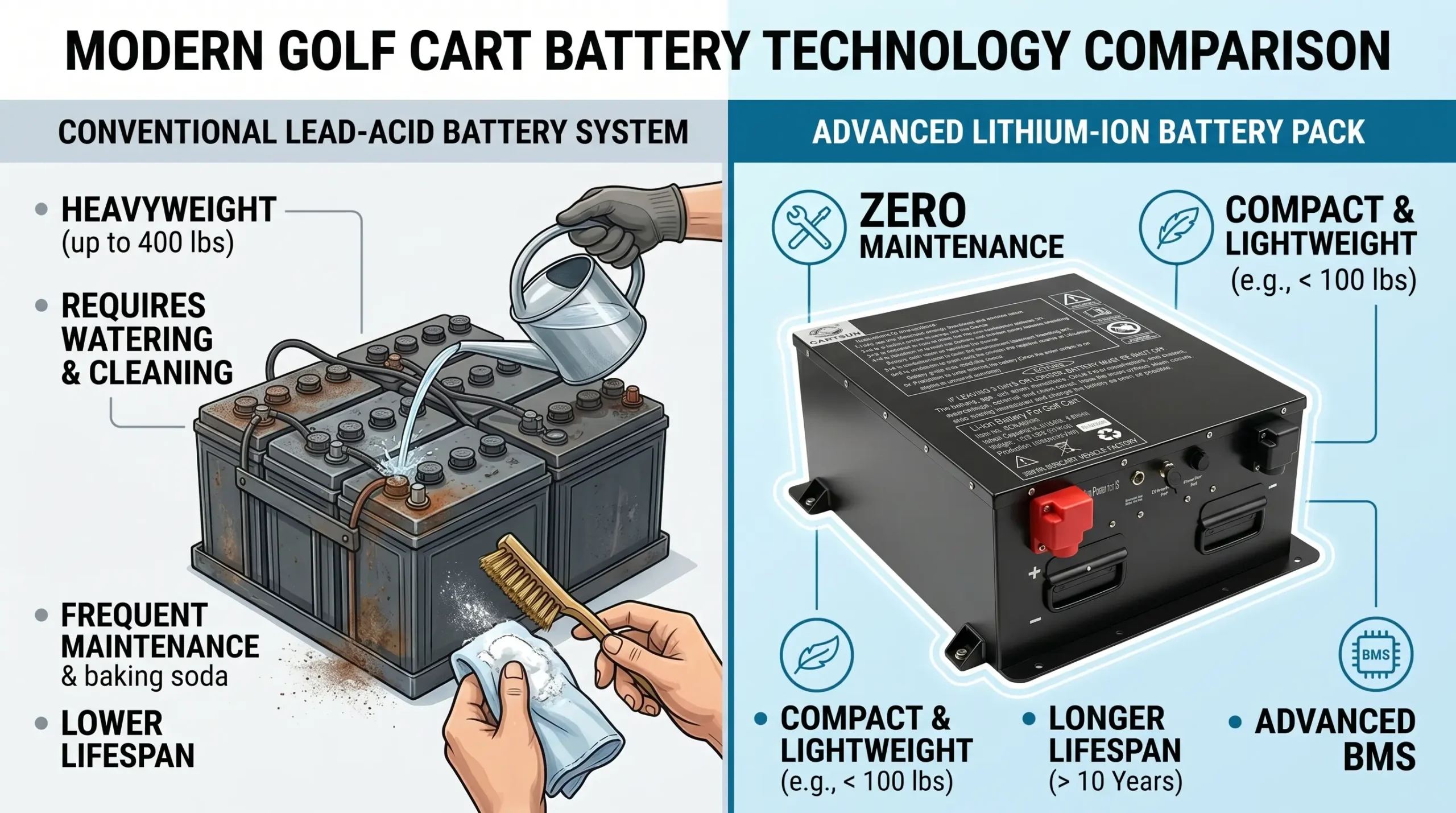
| Metric | Lead-Acid | Lithium (LiFePO₄) | What This Means for Your Fleet |
|---|---|---|---|
| Charge Time | 8-10 hours | 2-3 hours (to 80%) | Opportunity charging during breaks—less downtime, more trips per day |
| Lifespan | 2-4 years | 8-10 years | One battery purchase may outlast your ownership of the vehicle |
| Cycle Life | 300-500 cycles | 2,000-5,000 cycles | Lithium lasts 4-10 times longer |
| Weight (48V) | ~280 lbs | ~90 lbs | 65-70% weight reduction—less turf damage, better handling |
| Maintenance | Monthly watering, terminal cleaning | Zero | Eliminate labor hours currently spent on battery maintenance |
| Energy Efficiency | ~75% | 95%+ | Lower electricity costs per mile |
| Consistent Power | Slows down as battery drains | Full speed until empty | Reliable performance throughout the entire shift |
The fast replacement of lead-acid by lithium-ion battery technology is increasing market growth. Lithium batteries have a higher charging current, extended charge life, reduced weight and low maintenance, enhancing vehicle performance and lifecycle economics. The saving of downtime and operation is a great advantage to fleet operators.
The Total Cost of Ownership Advantage
While lithium batteries have a higher upfront cost, the total cost of ownership over 5-8 years is significantly lower. For a fleet of 20 carts operating daily:
Lead-acid: Expect 1-2 full battery replacements within 5 years, plus monthly maintenance labor.
Lithium: One battery purchase. Zero maintenance. 5-year warranty.
Declining lithium battery costs are also making electric vehicles more affordable for both consumers and manufacturers, accelerating adoption across personal and commercial transportation segments.
Sun-Cart’s Position: Every Sun-Cart electric golf cart is equipped with automotive-grade LiFePO₄ lithium batteries, backed by a 5-year warranty. Our 48V and 72V systems are designed for commercial-grade reliability, with zero maintenance required.
Actionable Takeaway for B2B Buyers: If you’re still operating lead-acid carts, the cost-benefit calculation in 2026 is straightforward. Lithium pays for itself within 2-3 years for daily-use fleets. Every year after that is pure savings.
Beyond the Course: Expanding Applications Driving Market Growth
Beyond the Course: Expanding Applications Driving Market Growth
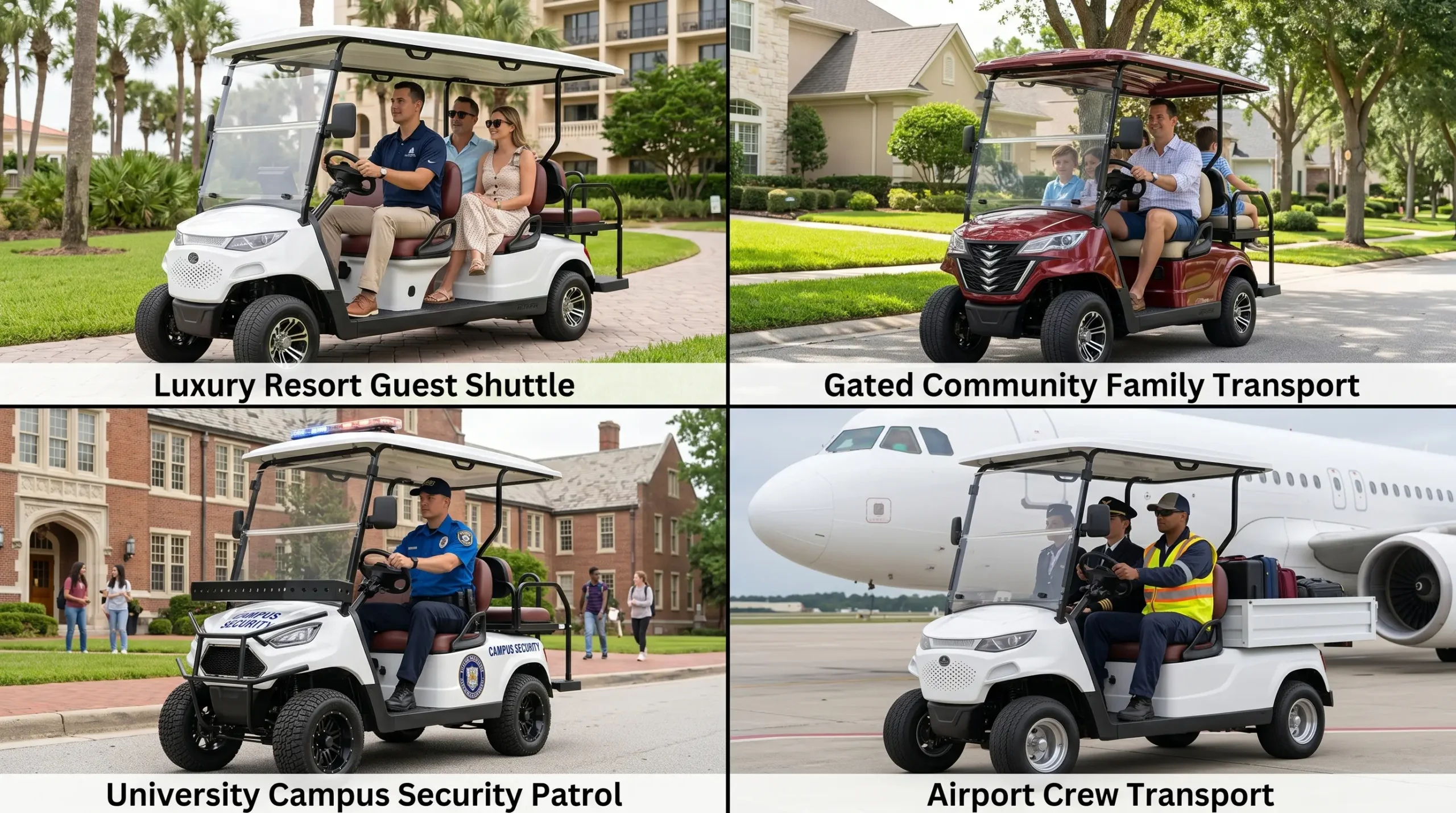
Electric golf carts are no longer confined to fairways. The market is being driven by expanding applications across multiple sectors:
| Application | Why It’s Growing | Recommended Configuration |
|---|---|---|
| Resorts & Hotels | Guests expect quiet, emission-free shuttles. Custom branding reinforces property image. | 4, 6, or 8 seats; LSV certified for public roads |
| Gated Communities & HOAs | LSV-certified vehicles serve as “second cars” for daily errands, social visits, and clubhouse trips | 2, 4, or 6 seats; street-legal certified |
| Corporate & University Campuses | Efficient transport for students, staff, and security personnel across large properties | 4 or 6 seats; GPS fleet tracking capable |
| Airports & Industrial Parks | Crew transport, cargo hauling, and security patrol in controlled environments | 2-seat utility or 6-seat shuttle; cargo bed options |
| Municipal & Public Safety | Parks maintenance, emergency response, and patrol applications | 2 or 4 seats with lighting and communication packages |
The growing interest in affordable electric mobility solutions is driving the growth of the electric golf cart market. Electric mobility solutions refer to transportation options powered primarily by electricity that aim to reduce reliance on fossil fuels and lower overall transportation costs. This trend, combined with expansion of golf course infrastructure, rising use in resorts, growth of gated communities, and increasing preference for quiet mobility solutions, has driven historic market growth.
Sun-Cart's 2026 Advantage: Compliance, Technology, and Reliability
Sun-Cart's 2026 Advantage: Compliance, Technology, and Reliability
As the industry navigates tariff turbulence, AI integration, and the lithium transition, Sun-Cart stands apart in three critical areas:
1. Uncompromising Compliance & Transparency
While 12 major importers face CBP investigations and potential 100-600% tariff penalties, Sun-Cart has maintained rigorous compliance standards. Our commitment to proper documentation, accurate tariff classification, and transparent supply chains ensures that our customers receive their vehicles on time, without unexpected cost increases or customs delays.
2. AI-Ready Smart Technology
Every Sun-Cart is built with FOC smart controllers and CAN bus communication architecture, designed to integrate seamlessly with third-party fleet management, telematics, and AI-driven optimization platforms. As autonomous features and AI-enabled fleet management become standard, Sun-Cart vehicles are ready.
3. Lithium Standard with 5-Year Warranty
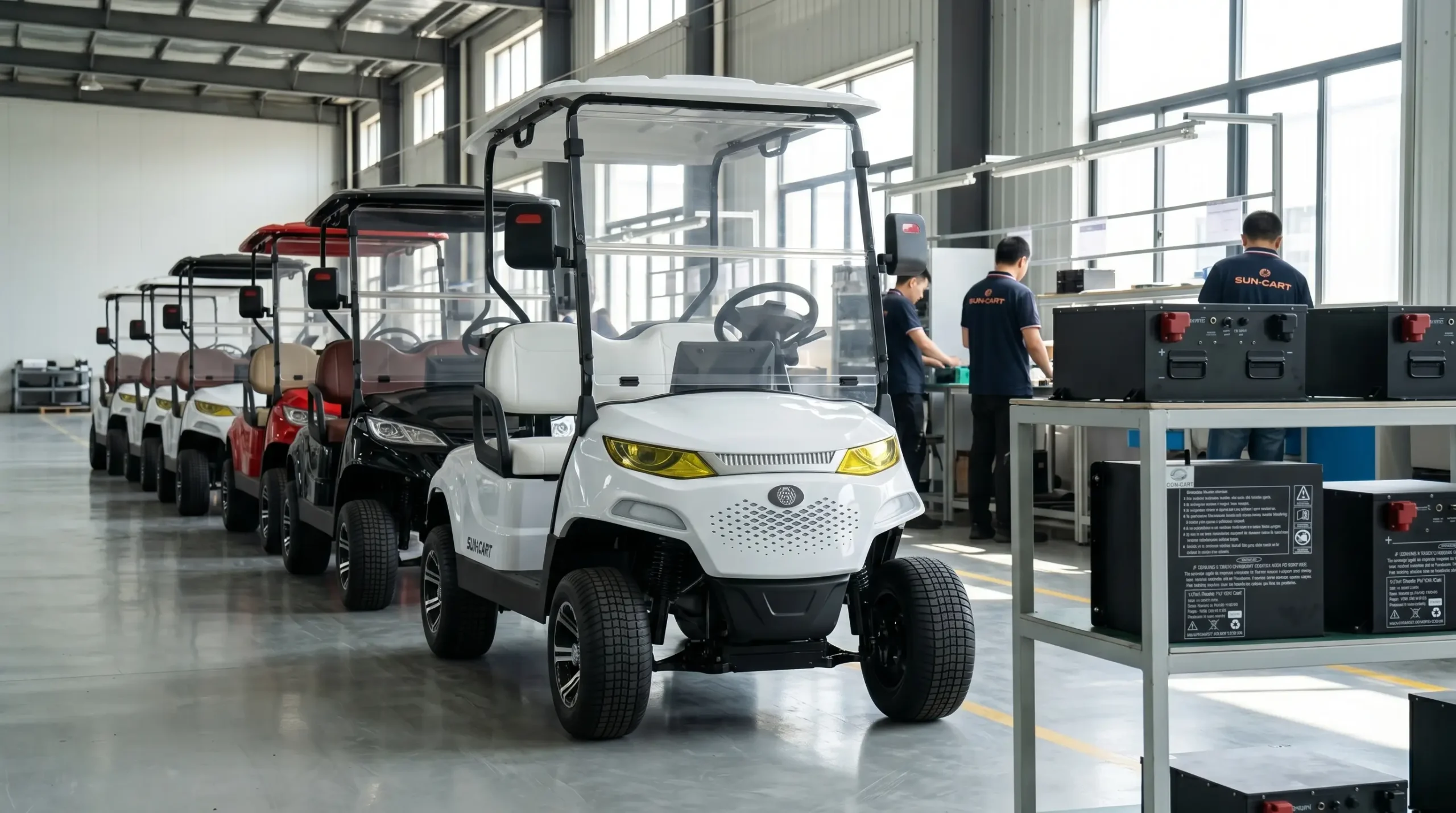
Sun-Cart has made lithium batteries the standard across all 2, 4, 6, and 8-seat models—48V or 72V, LiFePO₄ chemistry, zero maintenance, IP54 waterproof rating, and backed by a 5-year warranty. No hidden upgrade costs, no lead-acid compromises.
B2B Advantage: Sun-Cart offers complete customization—any color, any logo, custom seat upholstery, and accessory packages—with no MOQ for color changes. Free digital proof within 2-3 days. Production within 4-6 weeks.
Conclusion
Conclusion
The 2026 electric golf cart market is being shaped by three powerful forces: tariff-driven supply chain restructuring, rapid AI adoption, and the lithium battery tipping point. For B2B buyers, these trends create both challenges and opportunities.
Challenges: Rising costs from non-compliant suppliers, supply chain unpredictability, and the complexity of evaluating new smart technologies.
Opportunities: Working with compliant manufacturers who guarantee pricing and delivery, deploying AI-enabled fleets that reduce operational costs, and switching to lithium technology that delivers superior total cost of ownership.
Sun-Cart is positioned at the intersection of all three trends: full compliance with U.S. trade regulations, AI-ready smart technology as standard, and lithium batteries standard across every model with a 5-year warranty. The market is changing rapidly. The smart money is already moving.
Actionable Next Steps:
Verify your current or potential supplier’s compliance status.
Calculate your total cost of ownership for lithium vs. lead-acid.
Evaluate smart fleet features that could reduce your operational costs.
Contact Sun-Cart for a customized B2B quote.
Newsletter Updates
Enter your email address below and subscribe to our newsletter