Email:dennis@sun-cart.com Whatsapp:+86 13696971344
Why More Communities Are Switching to Electric Golf Carts: Cost Savings, Low Maintenance & LSV Laws
Across the United States, a quiet transportation shift is taking place. Gated communities, HOAs, retirement villages, and master‑planned developments are increasingly moving away from gas‑powered golf carts and full‑size cars. The vehicle of choice? Electric golf carts and Low‑Speed Vehicles (LSVs).
This change is not driven solely by environmental concerns — although zero emissions certainly help. For community managers and HOA boards, the decision rests on hard dollars, reduced maintenance, and legal practicality. Below is a data‑driven look at why electric communities are winning.
*Sun-Cart specializes in 2, 4, 6 and 8‑seat lithium electric golf carts and LSV‑certified street‑legal vehicles. Learn more about our electric golf cart lineup →
The Market Shift — NEVs Go Mainstream in Residential Life
The term “golf cart” no longer describes only the vehicle you rent at a clubhouse. Neighborhood Electric Vehicles (NEVs) — a category that includes LSVs, electric golf carts, and personal transport vehicles — are rapidly becoming everyday transportation for thousands of American households.
According to market data, the global NEV market is projected to grow from $4.2 billion in 2026 to $13.5 billion by 2033, a compound annual growth rate of 7.4%. North America holds the largest regional share, supported by about 16,000 U.S. golf courses, a mature regulatory framework for LSVs, and, most importantly, rapid adoption across residential communities.
In the United States alone, more than 1.2 million golf carts and NEVs are currently in active use, with an estimated 65% deployed in residential communities and retirement zones. In addition, 43 states permit NEVs on public roads where the speed limit is 35 mph or lower, leading to a 37% rise in street‑legal NEV registrations between 2022 and 2025.
Perhaps most telling: electric golf carts now represent 72% of new unit sales in the U.S., and lithium‑battery adoption has surpassed 52%. Communities are not waiting. They are already switching.

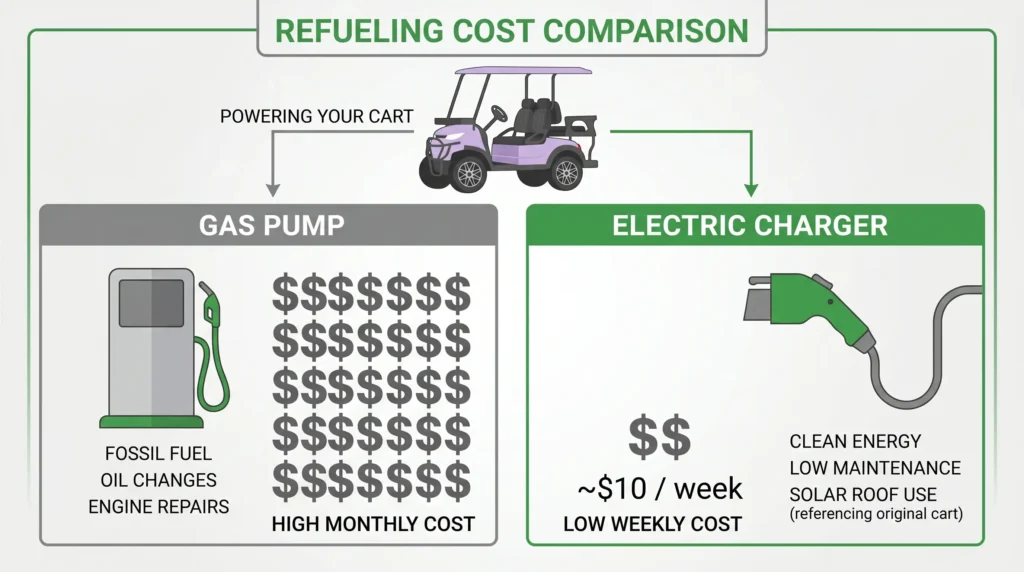
The High Cost of Gas — 5‑Year Operational Numbers
Fuel is a continuous, unpredictable expense. When a community runs a 50‑cart fleet, every fill‑up adds a real, recurring cost that never stops.
| Cost Type (per cart) | Gas Golf Cart | Electric Golf Cart (Lithium) |
|---|---|---|
| Energy / Fuel (5 yrs) | ~$5,000 | ~$2,000 |
| Maintenance (5 yrs) | ~$2,500 | ~$800 |
| 5‑Year Operating Total | ~$7,500 | ~$2,800 |
Based on typical fleet data and current utility/fuel prices.
Over five years, the cumulative impact for a 50‑cart HOA can exceed $160,000 in savings simply by choosing electric instead of gas. For most communities, the return on investment occurs within 18–24 months.
Even with higher upfront costs (a factory‑installed lithium pack costs roughly $2,500–$4,500 more than a comparable gas model), a 10‑year total‑cost‑of‑ownership (TCO) analysis strongly favors electric. Several independent studies conclude that electric golf carts are $3,000–$4,000 cheaper to own over a decade than gas carts, primarily because of lower fuel and maintenance expenses.
Maintenance — The Hidden Drain on HOA Budgets
Maintenance — The Hidden Drain on HOA Budgets
Maintenance is often the most underestimated cost in fleet operations. A gas golf cart has roughly 40+ moving wear parts in its drivetrain: oil, filters, belts, spark plugs, carburetors, and fuel systems. Each of these components can fail, and each requires labor hours.
An electric cart with a modern lithium battery, by contrast, has fewer than 10 drivetrain wear parts.
Gas carts require regular oil changes, filter replacements, belt adjustments, and fuel‑system maintenance. Unexpected breakdowns are common because combustion engines follow irregular failure curves. Commercial fleets that switch to electric typically reduce their maintenance workload by up to 50%.
Electric carts have no engine, no fuel system, and almost no routine mechanical service. Maintenance becomes predictable, and downtime is minimized.
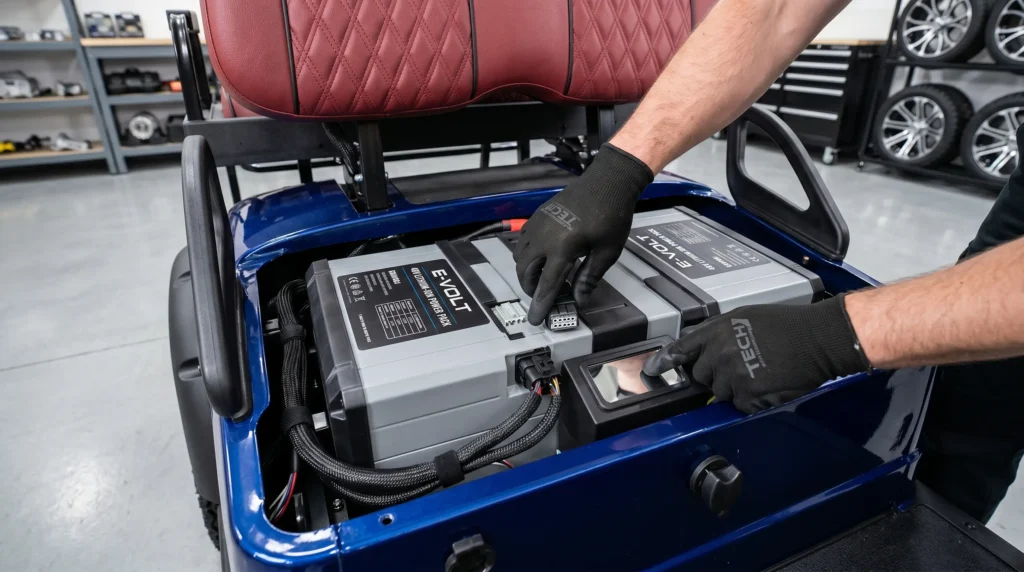
For an HOA or resort operating a 30‑vehicle fleet, the difference in annual maintenance cost alone can easily exceed $10,000–$15,000.
Even the traditional concerns around heavy lead‑acid battery maintenance are being eliminated. Lithium‑ion batteries require no watering, no terminal cleaning, and no equalization charges. With a lifespan of 8–10+ years under normal use (compared to 3–5 years for lead‑acid), lithium dramatically reduces both labor and long‑term replacement costs.
*Sun-Cart’s LiFePO₄ lithium batteries come with a 5‑year warranty and require zero maintenance. Explore our battery technology →*
Street‑Legal LSVs — The Regulatory Green Light
Street‑Legal LSVs — The Regulatory Green Light
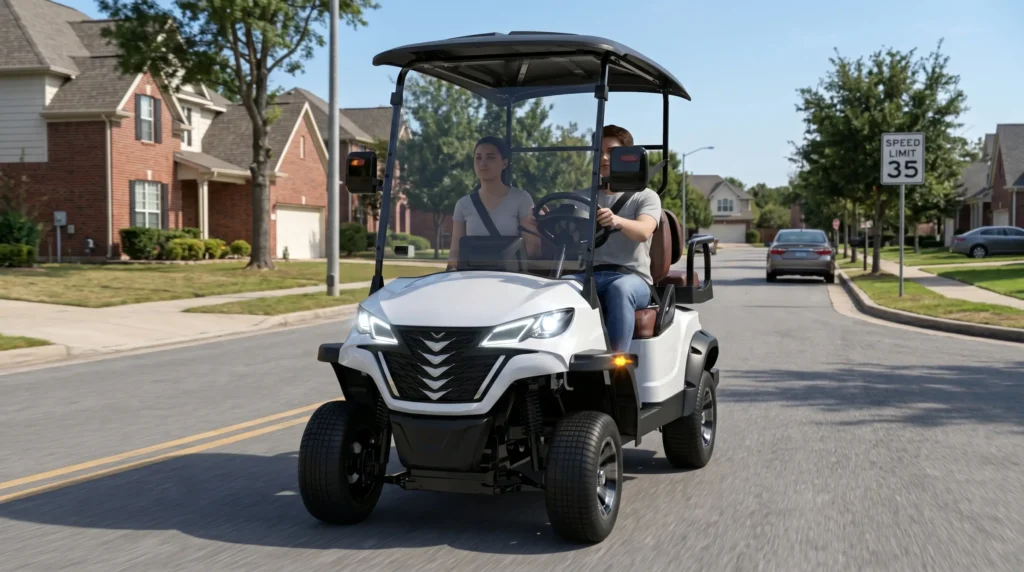
Not all golf carts can legally drive on public roads. A standard golf cart is designed for private property. LSV (Low‑Speed Vehicle) certification changes that entirely.
An LSV must comply with FMVSS 500 and come equipped with seat belts, headlamps, turn signals, mirrors, a windshield, and DOT‑approved tires. Once registered, an LSV can travel on roads with posted speed limits of 35 mph or less.
This regulatory shift has transformed how HOAs plan their transportation networks. In approximately 43 states, NEVs are permitted on low‑speed public roads. Communities such as The Villages in Florida and Sun City, Arizona are iconic examples where golf carts and LSVs are treated as primary daily drivers.
LSVs also make economic sense. Because they are smaller and simpler than conventional cars, purchase and operation costs are substantially lower. And because LSVs are fully electric, they share all the same fuel‑saving and low‑maintenance advantages as other electric carts.
Sun-Cart offers LSV‑certified models ready for DMV registration.
Real‑World Example — One Resort’s Electric Switch
Real‑World Example — One Resort’s Electric Switch
Understanding the numbers is helpful; seeing them in action is more persuasive. Consider a 40‑cart resort fleet in Orlando, Florida, that transitioned from gas to lithium‑electric vehicles.
Within 12 months of conversion:
Operating costs fell by 42%.
Maintenance downtime dropped from 12 hours/month to just 2 hours/month.
Noise complaints were completely eliminated.
The resort achieved full ROI in 22 months.
The fleet manager’s comment: “The only regret is not switching earlier.”
This kind of financial and operational benefit is being replicated across HOAs, retirement communities, and commercial campuses nationwide.

Which Community Should Go Electric?
The short answer: nearly any community that currently operates a gas‑powered fleet or where residents drive gasoline golf carts today.

Electric is the clear winner when:
✅ Charging infrastructure is available (overnight charging works for nearly all daily routes)
✅ Daily trips are predictable (short distances and regular stop‑and‑go use)
✅ The community values low noise, zero emissions, and reduced maintenance
Gas still has a role in limited situations:
❌ Remote properties without convenient overnight charging
❌ Extremely long daily driving routes exceeding 50 miles between charges
For the vast majority of gated communities, retirement villages, HOA‑governed neighborhoods, and resort properties, electric carts — especially with modern lithium batteries — deliver lower TCO, superior reliability, and a more pleasant residential experience.
Sun-Cart provides complete electric golf carts, LiFePO₄ battery packs, and AC motors — built for daily use in HOAs, resorts, and communities. Request a wholesale quote →
Make the Switch — Electric Fits Your Community
Make the Switch — Electric Fits Your Community
The evidence is clear: electric golf carts and LSVs lower costs, reduce maintenance burdens, and provide a better overall resident experience. With lithium‑ion technology now mainstream, upfront price gaps are narrowing, street‑legal LSV pathways are expanding, and the return on investment has become faster than ever.
For HOAs, property managers, and community boards, the decision is no longer about “if” — it is about how soon you can start saving.
📧 dennis@sun-cart.com
📞 WhatsApp: +86 19357388757
🌐 www.sungolfcarts.com
Sun-Cart supplies premium electric golf carts, lithium battery systems, and LSV‑certified vehicles to communities across North America, Europe, and Australia. In‑stock models ship from our US warehouse.
Newsletter Updates
Enter your email address below and subscribe to our newsletter